In the event of leakage in the primary circuit, the passive heat removal system assures the transition of steam generators to operation in the mode of condensation of the primary circuit steam. As a result, the condensate from steam generators arrives at the core providing additional cooling.
The passive water tank of the reactor building of Xudabao unit 4 consists of four modules, each of which is composed of reinforced concrete slabs, stainless steel cladding, penetrations, heat exchangers, and wall reinforcements. The hoisting weight of a single water tank module is 325.9 tonnes. The completed tank features 33 penetrations and 16 heat exchangers arranged within it.
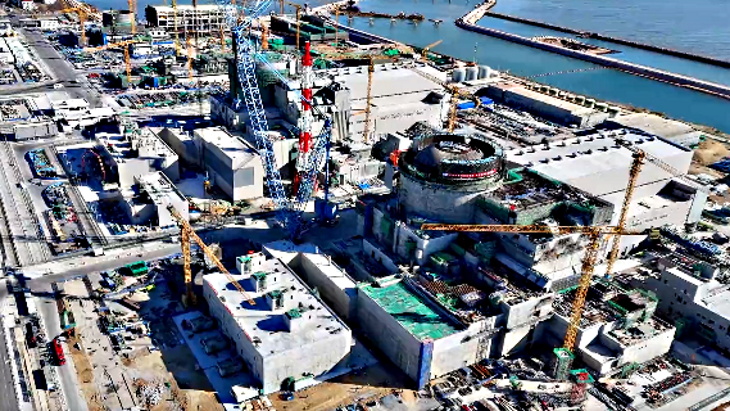
China National Nuclear Corporation (CNNC) said the installation of passive water tank marks “the full completion of the modular construction of large components for the second phase of the Xudabao nuclear power project, which lasted four years”.
It added: “Since the successful first hoisting of the unit 3 core shaft module on 18 November 2021, the project team has adhered to the principle of ‘converting non-modular components to modular ones and using modular components wherever possible’, continuously exploring and breaking through in modular construction. They successfully implemented a ‘four-in-one’ combined hoisting of the containment steel liner, through-hole components, steel truss, and horizontal steel mesh, creating a pioneering modular construction technology both domestically and internationally, greatly improving the inherent safety and quality of the project. From steel reinforcement and steel liner modules to complex precast concrete structural modules, the Xudabao project team, through countless finite element analyses and virtual simulation optimisations, controlled the hoisting accuracy to the millimetre level, far exceeding design requirements.
“Thus, the CNNC No.22 Xudabao Nuclear Power Project team has successfully explored and implemented a mature modular construction system applicable to the VVER-1200 reactor type, accumulating valuable experience for subsequent nuclear power project construction in China and setting a new benchmark for modular construction.”
The Xudabao (also known as Xudapu) project was originally expected to comprise six CAP1000 reactors- the Chinese version of the Westinghouse AP1000 – with units 1 and 2 in the first phase. Site preparation began in November 2010. The National Development and Reform Commission gave its approval for the project in January 2011. However, with a change in plans, construction of two Russian-supplied VVER-1200 reactors as Xudabao Phase II (units 3 and 4) began in July 2021 and May 2022, respectively. Commissioning of the units is scheduled for 2027 and 2028, respectively.
In November 2023, the Ministry of Ecology and Environment announced that the National Nuclear Safety Administration had decided to issue a construction licence for Xudabao units 1 and 2, which will both feature CAP1000 reactors.
Two further CAP1000 reactors are proposed for Phase III (units 5 and 6) at the Xudabao plant.
The Xudabao plant is owned by Liaoning Nuclear Power Company Ltd, in which CNNC holds a 70% stake with Datang International Power Generation Company holding 20% and State Development and Investment Corporation owning 10%.