Thursday, 17 April 2025
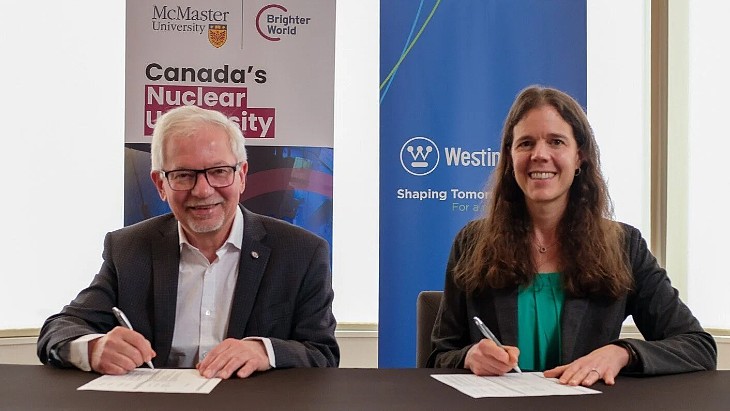
Under the agreements Westinghouse and McMaster University, which is based in Hamilton, Ontario, Canada, will collaborate on the research and development of the eVinci microreactor, including material irradiation and examination studies.
They build on existing collaboration since 2022 which has included McMaster “completing a material properties literature review along with corresponding material handbooks to inform engineering design and determine future testing needs”.
McMaster is expanding its reactor testing capabilities with a high-temperature irradiated test rig “which will enable Westinghouse to gather key testing data to support design confirmation and subsequent licensing approval of the eVinci microreactor”.
Westinghouse’s eVinci is a heatpipe-cooled microreactor which can produce up to 5 MWe with a 15 MWt core design. The TRISO-fuelled reactor core is designed to run for eight or more full-power years before refuelling, and the factory-built and assembled reactor can be shipped in a container to provide versatile, scalable energy for a variety of applications.
Jon Ball, President of Westinghouse eVinci Technologies, said: “McMaster University is a strong Canadian research partner, offering years of valuable experience and insights from operating its research reactor that can be applied to our microreactor technology. By broadening our collaboration and leveraging McMaster’s unique capabilities we can further accelerate the commercialisation of our eVinci microreactor.”
Andy Knights, McMaster’s acting Vice-President, Research, said: “We’re proud to partner with Westinghouse and contribute our research expertise and world-class suite of nuclear facilities in support of their eVinci microreactor programme. As Canada’s Nuclear University, McMaster is committed to working alongside our industry partners to advance materials and energy solutions for a cleaner world.”
Earlier this month the US Nuclear Regulatory Commission (NRC) approved the Principal Design Criteria, a key milestone towards licensing the eVinci microreactor in the USA. Principal Design Criteria – or PDCs – define how each part of the reactor’s structures, systems, and components will function, and ensure that the design conforms to design bases outlined in NRC regulations. Approval of these criteria provides a clear path to licensing the eVinci microreactor for deployment as well as simplifying and streamlining the licensing process for customers, Westinghouse said.
The Canadian Nuclear Safety Commission (CNSC) is also conducting a Vendor Design Review, and is currently assessing it as phase 2, which “has a focus on identifying potential fundamental barriers to licensing the NPP design in Canada. It serves to give the CNSC a significant level of assurance that the vendor has considered CNSC design requirements. The results of a Phase 2 review help the vendor develop a preliminary safety analysis report to support an eventual application for a licence to construct”.