Friday, 2 May 2025
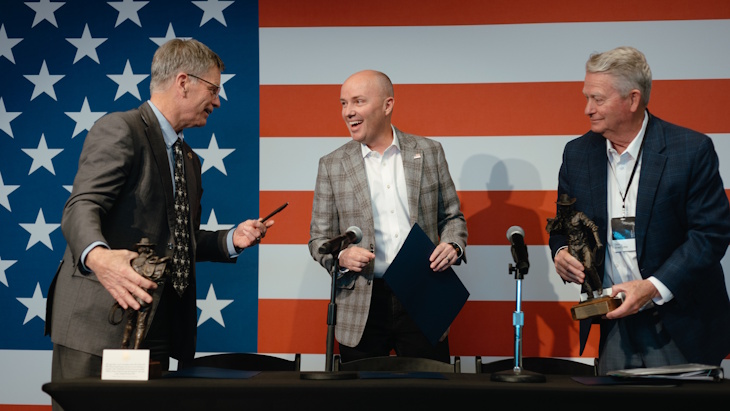
The tri-state memorandum of understanding (MoU) was signed by Governors Spencer Cox (Utah), Brad Little (Idaho) and Mark Gordon (Wyoming) on 30 April at the Built Here: Nuclear Energy Summit hosted by Cox. It establishes a cooperative framework to align energy-related efforts across the three states, focusing on advancing energy resilience, coordinating infrastructure, advocating for common sense federal policies, and accelerating the development of “reliable, affordable” nuclear energy.
Under the agreement, the three states will collaborate in areas including aligning their energy policies to support innovation and private investment; coordinating the development of critical energy infrastructure; jointly navigating regulatory and environmental challenges; and advocating for federal support of regional energy priorities; as well as enhancing energy resilience and grid reliability and expanding workforce development efforts to support the growing energy sector.
“Today in Utah, we brought together industry leaders, investors, and policymakers to chart the course for nuclear energy. Our new compact strengthens our shared commitment to aggressively pursue more affordable, reliable energy across state lines,” Cox said.
Earlier in the week, Utah state leaders signed into law several bills supporting Utah’s energy ambitions. These included , which supports project financing, workforce development, policy recommendations and regulatory frameworks to advance the deployment of nuclear and other energy technology in the state; a bill on advanced transmission technologies; and a bill providing for the creation of the energy compact between Utah, Wyoming and Idaho.
A third bill, , allows large load energy consumers needing 100 MW or more to enter into flexible contracts with existing utilities or alternative energy providers. These contracts allow providers to meet growing demands outside of normal regulatory processes while ensuring that large load consumers bear full costs and existing ratepayers are not negatively impacted, according to the Utah Senate.
Last year, Cox launched the initiative to double Utah’s power production over the next 10 years. The mission has four key goals: increasing transmission capacity; expanding and developing energy production; enhancing Utah’s policies to enable energy sources such as nuclear and geothermal; and investing in energy innovation and research.
Nuclear ecosystem
The strategic cooperation agreement signed by Holtec International with the State of Utah and Hi Tech Solutions covers collaboration to support the deployment of Holtec’s SMR-300 in Utah and the broader Mountain West region. Nuclear services provider Hi Tech will playing a leading role in the project development and workforce training to support new nuclear in the region.
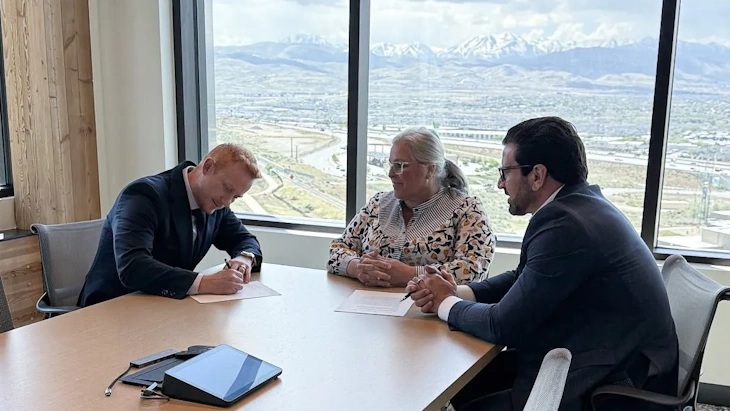
(L-R) Hi Tech Solutions President and COO Chris Hayter, State of Utah Office of Energy Development Director Emy Faulkner Lesofski, and Holtec President of Global Clean Energy Rick Springman signing the MoU on 29 April (Image: Holtec)
Holtec said it is finalising a plan for up to 4 GW of SMR-300s to be deployed in the 2030s, primarily focused in Utah and Wyoming and supported by ongoing testing at the Idaho National Labs. This follows its recent announcement of plans for an initial SMR-300 – a pressurised water reactor producing around 300 MW of electrical power or 1050 MW of thermal power for process applications – at Palisades in Michigan. Palisades will serve as the reference plant for the Mountain West buildout, Holtec said.
The agreement will see Holtec and Hi Tech work to build a permanent training facility in Utah by 2028 to focus on operations, maintenance and future technologies. This facility will focus on developing a skilled workforce for both the existing US reactor fleet and next-generation SMR technology through collaborations with Utah’s universities, technical colleges, and trade schools, the company said.
Holtec also said Utah will be the preferred destination for a western manufacturing location for SMR-300 reactors.
“We are not just delivering nuclear reactors; we have put together a plan to deliver the entire nuclear ecosystem to Utah and the surrounding region, inclusive of EPC delivery of the plants, manufacturing centres to produce major components, and workforce development tied to the specific delivery needs for the programme,” Holtec President of Global Clean Energy Opportunities Rick Springman said.
According to data from the US Energy Information Administration, 46% of Utah’s electricity net generation in 2023 came from coal-fired power plants, with 34% from gas and 11% from utility-scale solar power.
Holtec’s announcement comes days after EnergySolutions announced a partnership with the Intermountain Power Agency and the state of Utah to explore the potential development of small modular reactor for baseload power at the Intermountain Power Project site near Delta, Utah. A project between NuScale Power Corporation and Utah Associated Municipal Power Systems (UAMPS) – a political subdivision of the State of Utah – to build a small modular reactor power plant at a site near Idaho Falls was terminated in late 2023.
Article researched and written by WNN’s