Tuesday, 26 November 2024
_42999.jpg)
The cooperation agreement was signed in New York by Jam Pedersen, co-founder of Copenhagen Atomics, and Laura Salonga, vice president of industry relations at DeepGeo.
The partners said the agreement is “a first-of-a-kind for the global nuclear sector” and “represents a concrete step towards ensuring the long-term sustainability of nuclear energy”.
Important aspects of the collaboration include technology, fuel and waste characterisation and the legislation and regulations of handling, transporting and disposing of these materials between countries.
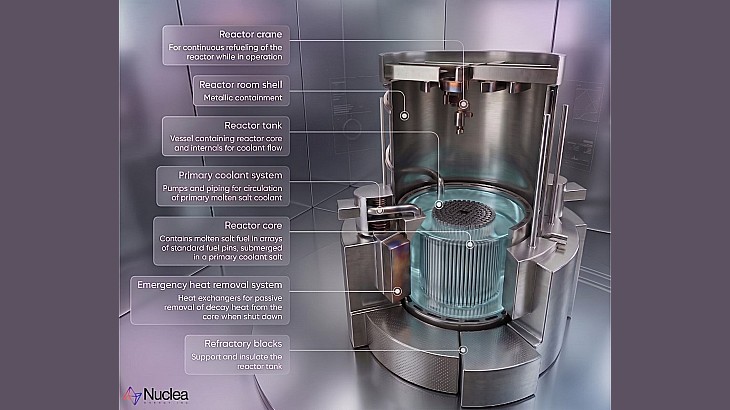
Copenhagen Atomics is developing a containerised molten salt reactor. Moderated with unpressurised heavy water, the reactor consumes nuclear waste while breeding new fuel from thorium. Small enough to allow for mass manufacturing and assembly line production, the reactor has an output of 100 MWt.
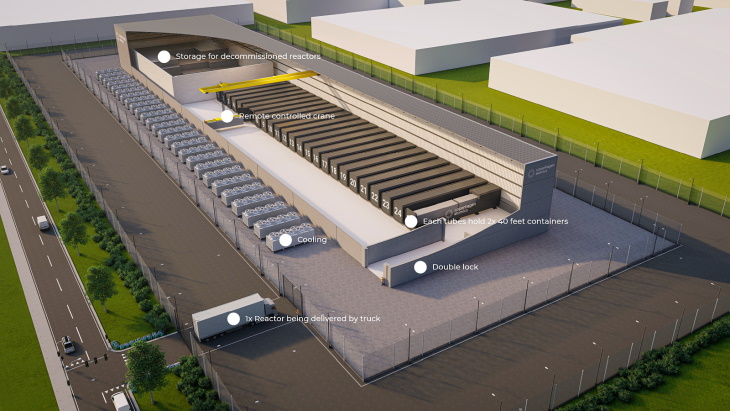 A visualisation of a 1 GW plant based on Copenhagen Atomics’ molten salt reactor (Image: UK Atomics)
Copenhagen Atomics’ thorium reactors are expected to consume the transuranic elements in used nuclear fuel from conventional nuclear reactors, which radically reduces the amount of long-lived radioactive waste.
To achieve this, Copenhagen Atomics intends to separate used nuclear fuel from light water reactors into four streams: zircaloy, uranium, fission products and transuranics. Its reactor designs can make use of plutonium (a transuranic) to ‘kickstart’ the use of thorium.
DeepGeo says it is committed to providing services related to medium and low-level waste management and disposal as Copenhagen Atomics begins testing and demonstration. Initially, the collaboration between the parties aims to help establish a better understanding of the economy and requirements of this process, determining what ultimately is waste and what has commercial value.
The establishment of multinational interim storage facilities and repositories that can host a variety of waste forms would provide vital flexibility in support of novel nuclear technologies, applications and business models, says DeepGeo.
“Copenhagen Atomics reactors are able to burn spent nuclear fuel and get 10 times more energy out of it, than when that same fuel is used in a traditional nuclear reactor,” Pedersen said. “Together with DeepGeo, Copenhagen Atomics will explore how we can make international handling of spent nuclear fuel radically more efficient and at the same time handle all waste streams responsibly.
“This partnership between Copenhagen Atomics and DeepGeo helps enable the conversion of spent nuclear fuel into a valuable resource rather than an expensive liability, which countries and companies have to deal with. Recycling a large share of spent nuclear fuel, this so-called ‘nuclear waste’, would allow them to sell it for a positive value, further covering the cost of recycling and transport.”
DeepGeo President Link Murray added: “An innovative nuclear sector needs innovative back-end solutions. We are thrilled to be partnering with Copenhagen Atomics, which is again demonstrating that it is a pioneer in the nuclear sector. Working together we can better understand the value of different fuel and waste needs of advanced nuclear reactors, help to accelerate their deployment and ensure the future sustainability of nuclear energy.”
The partners said they welcome interest from other nuclear technology and project developers that “are also ready to get serious about their future waste challenges” and explore innovative and multinational solutions.