Tuesday, 20 May 2025
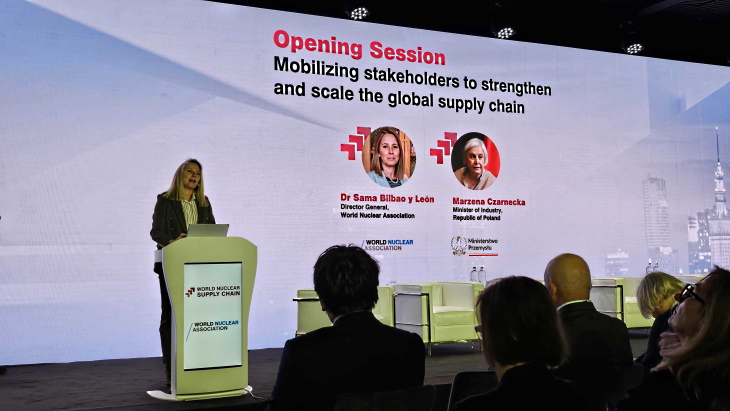
Opening its first World Nuclear Supply Chain conference – taking place in Warsaw, Poland, on 20-21 May – World Nuclear Association Director General Sama Bilbao y León noted: “The demand signal for nuclear projects gives high confidence for a near-term pipeline of opportunity coming. There is an around USD2 trillion investment opportunity for the global supply chain over the next 15 years.”
She noted that this figure comes from the most recent edition of the association’s World Nuclear Supply Chain Report, which was published in 2023, “before the announcement of tripling global nuclear capacity [by 2050] and before the recent boom in interest from end energy users”.
Bilbao y León told delegates there were currently 66 power reactors under construction around the world, with a further 400 reactor units at various degrees of project maturity and planning, totalling some 500 GWe of new capacity.
“It cannot be emphasised enough that a significant increase in the global nuclear supply chain capability and capacity will be required to build and deliver this expansion,” she said.
However, she stressed that “to deliver this expansion and accelerate deployment, governments need to move to a programmatic approach, not individual reactor projects, but programmes of nuclear reactors aligned with corresponding industrial policies. The supply chain is central to delivery, and a healthy supply chain requires government support and an environment that enables business and draws investment”.
Nuclear energy is “power for progress and social–economic development, delivering benefits to local communities as well as the wider world”, she added. She said it is important to find the balance between local, regional and global supply chains to unlock efficiency, ensure stability and secure growth.
“The term ‘glocalisation’ recognises this balance … to put it more simply is to think globally, while acting locally,” Bilbao y León said. “To achieve repeatable projects and deliver programmes we will need globalised supply chains, but these projects bring development and long-term local and regional benefits too.
“To deploy successfully, requires integration of many organisations, systems, and people for an effective delivery model. A successful supply chain is much more than the sum of its parts, it is not component manufacturing and assembly. This covers the full life cycle from development, construction, and operation through to decommissioning, focusing on nuclear-grade structures, systems, components, and services. As the industry moves to a programmatic approach, a comprehensive global nuclear supply chain is essential to deploy nuclear at scale.”
Bilbao y León said the industry recognises the nuclear sector has synergies with many other sectors, and that we “learn by doing” and that “learning reduces costs and brings economies of series”.
World Nuclear Association created World Nuclear Supply Chain as an opportunity to bring together and mobilise stakeholders, she said. She stressed that it is not just a conference but a platform for facilitating business-to-business engagements between buyers and suppliers and noted that Canada, China, Japan and South Korea had sent country delegations – comprising government and industry representatives – to the event. “Together, we can build a robust and effective global nuclear supply chain that meets the demands of the future,” Bilbao y León said.