Monday, 9 June 2025
According to the Chernobyl Nuclear Power Plant (ChNPP) state enterprise, “this will contribute to the development of the tourist attractiveness of the Slavutych community and the region as a whole, the preservation of historical memory, and the formation of a positive image both at the national and international levels”.
Slavutych was the city built 45 kilometres east of Chernobyl to house its workers evacuated from Pripyat which was three kilometres from the plant, after the 1986 accident.
The framework of the memorandum includes support for the city museum of Slavutych, the tourist information centre and expanding exhibitions related to the history of the Chernobyl nuclear power plant and “the construction of the cities of Pripyat and Slavutych, as well as the elimination of the consequences of the accident, which will contribute to a deeper understanding of the events of 1986”.
There are also proposals for “thematic excursions” and “joint tourist, cultural, educational and educational events – conferences, festivals, excursions, study tours for students, thematic events dedicated to the topics of Chernobyl, ecology and sustainable development with the involvement of specialists of the ChNPP State Enterprise and institutions and organisations of the city, scientists and tourists”.
Education of future generations of people in Slavutych is also seen as a key goal of the cooperation and “provides for joint participation in training courses, seminars for guides and researchers specialising in the topics of Chernobyl, nuclear energy, and ecology”.
The background
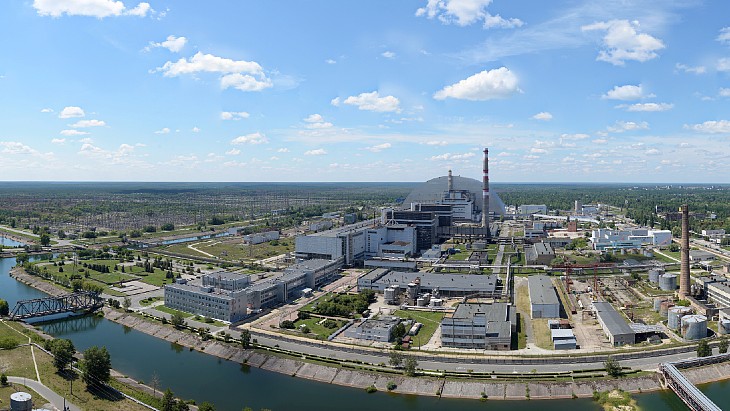
Following the Chernobyl accident in April 1986 (you can read more about it in the ) a 4200-square kilometre Chernobyl Exclusion Zone was established, which has been largely uninhabited since. A containment shelter was built at speed over the ruins of unit 4 after the accident and there has since been a giant new shelter – the New Safe Confinement built over it. The last operating unit at Chernobyl, unit 3 operated until 2000.
There was a developing tourist/visitor industry before the war with Russia began in 2022.
In 2019 a decree by Ukraine’s President Volodymyr Zelensky titled “On the development of areas affected by radioactive contamination due to the Chernobyl disaster” aimed to begin turning the exclusion zone into one of the growth points of the new Ukraine.
It aimed to remove a ban on filming in the area and to “popularise” tourism in Chernobyl at international events. “We must give this territory of Ukraine a new lease of life. Until now, Chernobyl has been a negative component of the Ukrainian brand. It’s time to change that. We must showcase this place to the world: to scientists, ecologists, historians, tourists,” he said at the time.
As well as the historical and educational potential of the area, the exclusion zone has become what the United Nations’ environment programme describes as “a haven for wildlife, with lynx, bison, deer and other animals roaming through thick forests” in “the third-largest nature reserve in mainland Europe and an iconic – if accidental – experiment in rewilding”.
However tourism to the area halted after the Russian invasion in February 2022, which saw its forces taking control of the Chernobyl plant and area for two months before they withdrew. The war continues and in February by a drone strike.