Monday, 16 June 2025
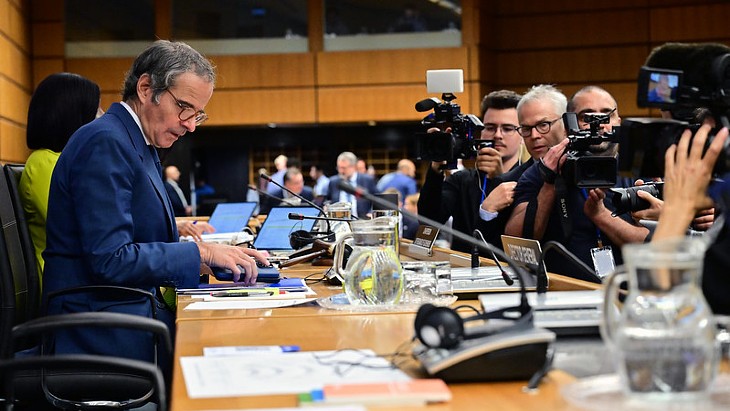
He said there had been no additional damage at the site since Friday, saying: “Electricity infrastructure at the facility, which included an electrical sub-station, a main electric power supply building, and emergency power supply and back-up generators, was also destroyed.
“There has been no indication of a physical attack on the underground cascade hall containing part of the Pilot Fuel Enrichment Plant and the main Fuel Enrichment Plant. However, the loss of power to the cascade hall may have damaged the centrifuges there. The level of radioactivity outside the Natanz site has remained unchanged and at normal levels, indicating no external radiological impact to the population or the environment from this event.
“Within the Natanz facility there is both radiological and chemical contamination. Considering the type of nuclear material at this facility, it is possible that uranium isotopes contained in uranium hexafluoride, uranyl fluoride and hydrogen fluoride are dispersed inside the facility. The radiation, primarily consisting of alpha particles, poses a significant danger if uranium is inhaled or ingested. However, this risk can be effectively managed with appropriate protective measures, such as using respiratory protection devices while inside the affected facilities. The main concern inside the facility is the chemical toxicity of the uranium hexafluoride and the fluoride compounds generated at the contact with water.”
He added: “At the Esfahan nuclear site, four buildings were damaged in Friday’s attack: the central chemical laboratory, a uranium conversion plant, the Tehran reactor fuel manufacturing plant, and the UF4 to EU metal processing facility, which was under construction. As in Natanz, off-site radiation levels remain unchanged.”
Grossi said that Iran’s Bushehr nuclear power plant has not been targeted, and no damage had been reported at the Fordow Fuel Enrichment Plant, the Khondab heavy water reactor or the Tehran Research Reactor. “The Agency is and will remain present in Iran. Safeguards inspections in Iran will continue as soon as safety conditions allow, as is required under Iran’s NPT safeguards obligations.”
He repeated his calls for the maximum restraint to be shown by all parties and said there “is always time and there is always a place for diplomacy … military escalation threatens lives, increases the chance of a radiological release with serious consequences for people and the environment and delays indispensable work towards a diplomatic solution for the long-term assurance that Iran does not acquire a nuclear weapon.”
Israel said that its actions have been a pre-emptive move targeting what it called Iran’s programme to develop nuclear weapons and to “neutralise an immediate and existential threat to our people”. Iran says that its nuclear programme is peaceful.
Iran’s enrichment facilities
Unenriched, or natural, uranium contains about 0.7% of the fissile uranium-235 (U-235) isotope. (“Fissile” means it’s capable of undergoing the fission process by which energy is produced in a nuclear reactor). The rest is the non-fissile uranium-238 isotope. Most nuclear reactors need fuel containing between 3.5% and 5% U-235 – known as low-enriched uranium, or LEU. Advanced reactor designs that are now being developed – and many small modular reactors – and research reactors, which are often used to produce medical radioisotopes, amongst other things – will require higher enrichments still – typically up to 20%.
Enrichment increases the concentration of the fissile isotope by passing the gaseous uranium hexafluoride (UF6) through so-called cascades of gas centrifuges, in which a fast spinning rotor inside a vacuum casing makes use of the very slight difference in mass between the fissile and non-fissile isotopes to separate them.
But the same technology that is needed to enrich uranium for use in nuclear power or research reactors could also be used to enrich uranium to the much higher levels (90% U-235 and above) that could be used in nuclear weapons. This means that uranium enrichment is strategically sensitive from a non-proliferation standpoint, so there are strict international controls to ensure that civilian enrichment plants are not used in this way.
Iran is known to operate enrichment plants at Natanz, about 80km southeast of Qom, and Fordow, 20km north of Qom.
According to World Nuclear Association, there are two enrichment plants at Natanz: the Pilot Fuel Enrichment Plant, with two cascades designated for production of uranium enriched up to 20% U-235, ostensibly for the Teheran Research Reactor, and R&D purposes; and the Fuel Enrichment Plant, which is built underground.
In a quarterly report, published on 31 May, the IAEA verified that cascades at the Fuel Enrichment Plant were being fed with natural UF6 to produce material enriched up to 5% U-235. It verified that Iran was testing some centrifuges and feeding both natural and depleted UF6 into others in the various R&D production lines at the Pilot Fuel Enrichment Plant.
According to the IAEA’s quarterly report, as of 27 May some 82 cascades were operational at the Fuel Enrichment Plant, with seven operational cascades at the Pilot Fuel Enrichment Plant. The Fuel Enrichment Plant had produced an estimated 2671.3 kg of UF6 enriched up to 5% since its previous report. The pilot plant had produced 19.2 kg of uranium enriched up to 60%, about 243 kg with up to 5% enrichment and 453 kg with enrichment up to 2% U-235.
The Fordow Fuel Enrichment Plant has 13 operating cascades, according to the IAEA, where over 166 kg of UF6 enriched up to 60% U-235 were produced since the agency’s previous quarterly report, as well as 67 kg of material enriched up to 20%, 724.5 kg enriched up to 5%, and nearly 369 kg of up to 2% enrichment.
The agency said that Iran’s total inventory of enriched uranium as of 27 May stood at 2221.4 kgU of material with an enrichment of up to 2%; 5508.8 kgU up to 5%, 274.5 kgU up to 20% and 408.6 kgU with up to 60% enrichment.
The UF6 feedstocks – natural and depleted UF6 – have low levels of radioactivity, but significant chemical toxicity, so have to be handled appropriately, as does the enriched uranium product. The materials themselves are stored in purpose-built cylinders to provide the necessary physical protection.