South Korean Researchers Develop Breakthrough Catalyst for Low-Cost Hydrogen Production

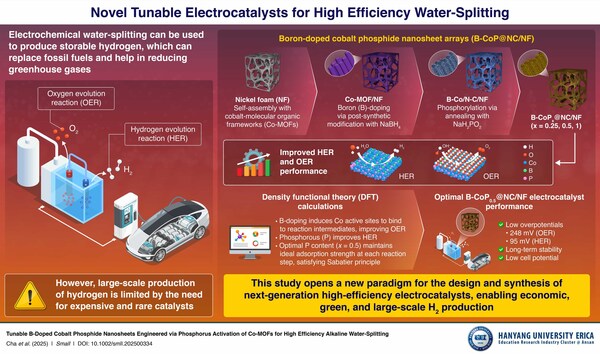
The novel electrocatalysts, developed using metal-organic frameworks, feature excellent electrocatalytic performance and high efficiency, while also having a low cost. These electrocatalysts have the potential to enable large-scale hydrogen production, which can help in reducing greenhouse gas emissions.

Hydrogen is a clean energy source that can help fight climate change. It produces no carbon emissions and stores more energy by weight than gasoline. One way to make hydrogen is by electrochemical water-splitting, which splits water into hydrogen and oxygen. But this method needs rare and costly catalysts, making large-scale production difficult. Researchers are now working to create cheaper, more efficient alternatives.

A team from Hanyang University ERICA campus in South Korea, led by Professor Seunghyun Lee and Mr. Dun Chan Cha, has made a breakthrough. They developed new electrocatalysts using boron-doped cobalt phosphide nanosheets from metal-organic frameworks. These catalysts are efficient, stable, and low-cost. They performed well in both hydrogen evolution (HER) and oxygen evolution (OER) reactions. An alkaline electrolyzer using these materials outperformed many current systems and remained stable for over 100 hours. Their findings were also backed by DFT calculations, confirming the role of boron and phosphorus tuning in boosting performance.

Commenting on the study, Prof. Lee said, “We have successfully developed cobalt phosphides-based nanomaterials by adjusting boron doping and phosphorus content using metal-organic frameworks. These materials have better performance and lower cost than conventional electrocatalysts, making them suitable for large-scale hydrogen production.” 
 

  • Related Posts

    Top Stories Of The Day: India Strengthens Grid for 500 GW Clean Power; Solex 3.78 GW Module Plant Added to ALMM and More…

    India is accelerating grid infrastructure upgrades to integrate more than 500 GW of non-fossil fuel capacity by 2030. The expansion includes transmission corridors, substations, and advanced grid management systems to…

    Explained – Understanding Solar + Storage: How Solar Panels And Batteries Work Together

    Representational image. Credit: Canva Solar panels, also called photovoltaic (PV) panels, are devices that convert sunlight into electricity. They are made up of many solar cells, usually made of silicon,…

    Have You Seen?

    IEA Proposes Largest Ever Oil Release From Strategic Reserves, WSJ Reports

    • March 11, 2026
    IEA Proposes Largest Ever Oil Release From Strategic Reserves, WSJ Reports

    Oil Shrugs Potential IEA Reserves Release, Gains on Supply Worries

    • March 11, 2026
    Oil Shrugs Potential IEA Reserves Release, Gains on Supply Worries

    SLB Provides Update on Middle East Operations and First Quarter Outlook

    • March 11, 2026
    SLB Provides Update on Middle East Operations and First Quarter Outlook

    Japan’s electronics gas industry continues to shrink

    • March 11, 2026
    Japan’s electronics gas industry continues to shrink

    Chevron and Shell Move Closer to New Oil Deals in Venezuela

    • March 11, 2026
    Chevron and Shell Move Closer to New Oil Deals in Venezuela

    Qatar’s LNG Shutdown Sends Shockwaves Through Global Gas Markets

    • March 11, 2026
    Qatar’s LNG Shutdown Sends Shockwaves Through Global Gas Markets

    Tankers Avoid Emirati Port as Gulf War Risk Disrupts Oil Exports

    • March 11, 2026
    Tankers Avoid Emirati Port as Gulf War Risk Disrupts Oil Exports

    Cargo Ship Hit by Projectile in Strait of Hormuz as Tanker Crisis Continues

    • March 11, 2026
    Cargo Ship Hit by Projectile in Strait of Hormuz as Tanker Crisis Continues

    Crude Oil Jumps 4% as Traders Price In Supply Disruption

    • March 11, 2026
    Crude Oil Jumps 4% as Traders Price In Supply Disruption

    EU approves funding for Air Liquide BASF Belgium CCS project

    • March 11, 2026
    EU approves funding for Air Liquide BASF Belgium CCS project