Monday, 2 December 2024
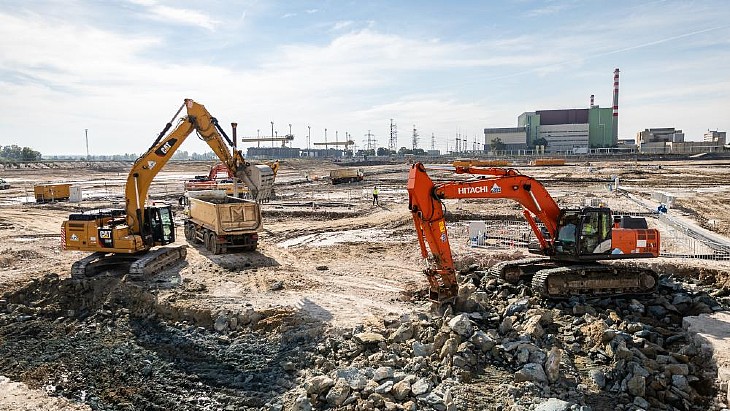
Szijjártó said that the regulator’s lifting of the retention point was one of the most important milestones for the construction project, saying “this is a serious document with a total volume of half a million pages, which meets the standards of the International Atomic Energy Agency”. He also noted that the site officially gets the status of a nuclear facility under construction once first concrete is poured.
Excavation of soil to a depth of 23 metres is under way and 39,000 of the 75,000 piles that need to be drilled into the ground during soil consolidation are in place he said, adding: “There are already thousands of people working in the work area.”
The first large-scale nuclear power plant equipment – the core catcher – was delivered to the site in August. Also known as a melt trap, the core catcher is a container in the form of a cone made of thermally resistant steel which in the unlikely event of an emergency will securely hold the melt of the core and not allow radioactive substances to leave the containment of the reactor.
In its official announcement of the decision, the National Atomic Energy Agency (Országos Atomenergia Hivatal, OAH) said it had “decided to lift the retention point specified in the construction permit for new nuclear power plant blocks. After that, it is possible to start significant activities (but requiring additional permits), such as the so-called first concrete pouring, during which the first concreting works of the new block’s nuclear island are carried out”.
“There are a number of technical and administrative conditions for the start of this activity, one of which was the lifting of the holding point specified in the establishment permit – in this procedure. The first concrete pouring has additional conditions prescribed in other permits, such as, for example, obtaining a permit for use of soil consolidation. During construction, the OAH constantly checks compliance with the legal requirements and the conditions laid down in the permits in the framework of ad hoc, announced or unannounced, as well as comprehensive inspections.”
The Paks II project was launched in early 2014 by an intergovernmental agreement between Hungary and Russia for two VVER-1200 reactors to be supplied by Rosatom, with the contract supported by a Russian state loan to finance the majority of the project. The construction licence application was submitted in July 2020 to build Paks II alongside the existing Paks plant, 100 kilometres southwest of Budapest on the banks of the Danube River. The construction licence was issued in August 2022 and a construction timetable agreed last year which set out plans to connect the new units to the grid at the beginning of the 2030s.
The existing four units at Paks are VVER-440 reactors that started up between 1982 and 1987 and they produce about half of the country’s electricity. Their design lifetime was for 30 years but that was extended in 2005 by 20 years to between 2032 and 2037. The Hungarian Parliament approved a proposal in 2022 to further extend their lifespan, which means preparations can begin on operating the plant into the 2050s.