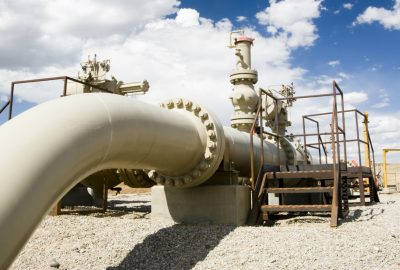
The Appalachia shale fields, which cover the Marcellus and Utica formations, have the largest gas reserves in the U.S., but energy companies have limited ability to move more of that fuel to the rest of the country because most existing pipelines are already near full. In addition, companies have found it tough to build new projects in the region due to legal and regulatory pushback from states and local and environmental groups.
Get the Latest US Focused Energy News Delivered to You! It’s FREE:
Output growth in the region, which produces about a third of the nation’s gas, has stalled in recent years after some firms lost billions on delayed or canceled pipes.
But now, as Trump rolls back regulations to boost domestic energy production, several U.S. firms, including Williams Cos, Boardwalk Pipeline, DT Midstream and EQT, have proposed building or expanding pipelines and other infrastructure in the Northeast.
“We are actively evaluating opportunities to expand infrastructure,” Amy Rogers, spokeswoman at EQT, the nation’s second-biggest gas producer with operations in Appalachia, told Reuters.
“Enhancing pipeline capacity is essential to unlocking Appalachian supply,” she said.
LNG EXPORTS BOOST GAS DEMAND
In 2024, the U.S. produced about 103.2 billion cubic feet per day (bcfd) of gas and consumed a record 90.5 bcfd of the fuel, according to U.S. Energy Information Administration data.
One billion cubic feet of gas is enough to supply about 5 million U.S. homes for a day. Analysts expect that new LNG export plants and electric generation facilities to power artificial intelligence at data centers will push U.S. power and gas demand to record highs in 2025 and 2026 and beyond.
Output from Appalachia has increased every year since at least 2009 when the region produced just 1.7 bcfd of gas. Lack of pipeline capacity, however, has slowed that growth to an average of just 2% a year from 2020 to 2024 versus an average of 15% a year from 2015 to 2019, according to EIA data.
Looking forward, output in the region is expected to grow by an average of only 1% a year in 2025 and 2026 – to 36.2 bcfd and 36.6 bcfd, respectively – according to EIA projections.
New infrastructure, coupled with growing energy needs in the U.S., could add up to 5 bcfd of new demand for Appalachia gas supplies through 2030, said Jack Weixel, an analyst with consultancy East Daley Analytics.
“That is definitely a lot more than anyone was expecting from Appalachia just a mere 12 months ago,” he said.
CONSTITUTION AND OTHER PIPES
Support from the Trump administration has already prompted pipeline operator Williams to begin reviving two canceled projects to transport gas from Pennsylvania: the 0.65 bcfd Constitution Pipeline to New York and the 0.4 bcfd Northeast Supply Enhancement to New Jersey and New York.
“The NESE and Constitution projects are essential to address persistent natural gas supply constraints in the Northeast, constraints that have led to higher energy costs for consumers,” said a spokesperson for Williams.
During the winter of 2024-2025, it cost about twice as much to heat a home with oil than with gas, according to federal energy estimates. More than 80% of the roughly 4.6 million U.S. homes still using heating oil as their primary heating fuel in 2024 were located in the Northeast region.
Williams canceled Constitution in 2020 and NESE in 2024 after years of fighting for permits, especially water permits, from state regulators.
State environmental regulators in New York and New Jersey did not comment directly on Williams filings to revive the NESE project, which runs through both states.
In New York, Millennium Pipeline, meanwhile, said it plans to begin negotiations for binding commitments for a proposed expansion that could add up to 0.5 bcfd of capacity to its existing 2.0 bcfd pipe.
High interest from shippers underscored the need for additional pipeline capacity in the region, Millennium said, which anticipates that the expansion, if approved by its owners, could start service by late 2029.
Millennium is owned by units of DT Midstream and Canadian energy firm TC Energy.
Meanwhile, EQT and partners want to extend their existing 2.0 bcfd Mountain Valley Pipeline from West Virginia to Virginia into North Carolina with the proposed 0.55 bcfd Southgate expansion project.
The $7.85 billion Mountain Valley Pipeline, which entered service in 2024 and whose construction cost was more than twice the amount originally planned, was the last big pipeline to enter service in the Northeast region after years of delays.
In Ohio, Boardwalk Pipelines said it is evaluating interest for its proposed Borealis pipeline project, which could create up to 2.0 bcfd of incremental transportation to markets from Ohio to Louisiana.
Still, despite Trump’s pro-energy policies, some of the same headwinds pipeline projects faced in the past are likely to resurface. Several organizations, including the Sierra Club environmental group, have already filed protests against Williams’ NESE with the U.S. Federal Energy Regulatory Commission, which oversees federal permitting of gas pipeline projects.
“The Northeast does not need more gas pipelines that pollute our neighborhoods and leave us vulnerable to price spikes from global volatility, especially as gas demand locally is already beginning to wane,” Jasmine Vazin, director of the Beyond Dirty Fuels campaign at the Sierra Club, told Reuters in an email.
Share This:
More News Articles