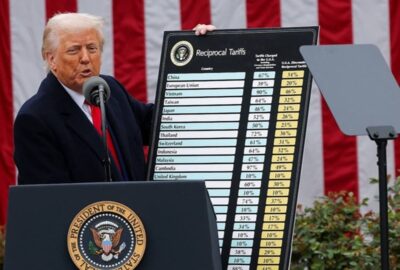
On inauguration day, the effective U.S. tariff rate was about 2.5%. It has since jumped to somewhere between 17% and 19%, according to a range of estimates. The Atlantic Council estimates it will edge closer to 20%, the highest in a century, with higher duties taking effect on Thursday.
Get the Latest US Focused Energy News Delivered to You! It’s FREE:
Trading partners have largely refrained from retaliatory tariffs, sparing the global economy from a more painful tit-for-tat trade war. Data on Tuesday showed a 16% narrowing of the U.S. trade deficit in June, while the U.S. trade gap with China shrank to its smallest in more than 21 years.
American consumers have shown themselves to be more resilient than expected, but some recent data indicate the tariffs are already affecting jobs, growth and inflation.
“The question is, what does winning mean?” said Josh Lipsky, who heads economic studies at the Atlantic Council. “He’s raising tariffs on the rest of the world and avoiding a retaliatory trade war far easier than even he anticipated, but the bigger question is what effect does that have on the U.S. economy.”
Michael Strain, head of economic policy studies at the conservative American Enterprise Institute, said Trump’s geopolitical victories could prove hollow.
“In a geopolitical sense, Trump’s obviously getting tons of concessions from other countries, but in an economic sense, he’s not winning the trade war,” he said. “What we’re seeing is that he is more willing to inflict economic harm on Americans than other countries are willing to inflict on their nations. And I think of that as losing.”
Kelly Ann Shaw, a White House trade adviser during Trump’s first term who is now a partner at Akin Gump Strauss Hauer & Feld, said a still-strong economy and near-record-high stock prices “support a more aggressive tariff strategy.”
But Trump’s tariffs, tax cuts, deregulation and policies to boost energy production would take time to play out.
“I think history will judge these policies, but he is the first president in my lifetime to make major changes to the global trading system,” she added.
DEALS SO FAR
Trump has concluded eight framework agreements with the European Union, Japan, Britain, South Korea, Vietnam, Indonesia, Pakistan and the Philippines that impose tariffs on their goods ranging from 10% to 20%.
That’s well short of the “90 deals in 90 days” administration officials had touted in April, but they account for some 40% of U.S. trade flows. Adding in China, currently saddled with a 30% levy on its goods but likely to win another reprieve from even higher tariffs before an August 12 deadline, would raise that to nearly 54%.
Deals aside, many of Trump’s tariff actions have been mercurial.
On Wednesday he ratcheted up pressure on India, doubling new tariffs on goods from there to 50% from 25% because of its imports of oil from Russia. The same rate is in store for goods from Brazil, after Trump complained about its prosecution of former leader Jair Bolsonaro, a Trump ally. And Switzerland, which Trump had previously praised, is facing 39% tariffs after a conversation between its leader and Trump derailed a deal.
Ryan Majerus, a trade lawyer who worked in both the first Trump administration and the Biden government, said what’s been announced so far fails to address “longstanding, politically entrenched trade issues” that have bothered U.S. policymakers for decades, and getting there would likely take “months, if not years.”
He also noted they lack specific enforcement mechanisms for the big investments announced, including $550 billion for Japan and $600 billion for the EU.
PROMISES AND RISKS
Critics lit into European Commission President Ursula von der Leyen after she agreed to a 15% tariff during a surprise meeting with Trump during his trip to Scotland last month, while gaining little in return.
The deal frustrated winemakers and farmers, who had sought a zero-for-zero tariff. Francois-Xavier Huard, head of France’s FNIL national dairy sector federation, said 15% was better than the threatened 30%, but would still cost dairy farmers millions of euros.
European experts say von der Leyen’s move did avert higher tariffs, calmed tensions with Trump, averting potentially higher duties on semiconductors, pharmaceuticals and cars, while making largely symbolic pledges to buy $750 billion of U.S. strategic goods and invest over $600 billion. Meeting those pledges will fall to individual EU members and companies, and cannot be mandated by Brussels, trade experts and analysts note.
U.S. officials insist Trump can re-impose higher tariffs if he believes the EU, Japan or others are not honoring their commitments. But it remains unclear how that would be policed.
And history offers a caution. China, with its state-run economy, never met its modest purchase agreements under Trump’s Phase 1 U.S.-China trade deal. Holding it to account proved difficult for the subsequent Biden administration.
“All of it is untested. The EU, Japan and South Korea are going to have to figure out how to operationalize this,” Shaw said. “It’s not just government purchases. It’s getting the private sector motivated to either make investments or back loans, or to purchase certain commodities.”
And lastly, the main premise for the tariffs Trump has imposed unilaterally faces legal challenges. His legal team met with stiff questioning during appellate court oral arguments over his novel use of the 1977 International Emergency Economic Powers Act, historically used for sanctioning enemies or freezing their assets, to justify his tariffs. A ruling could come any time and regardless of the outcome seems destined to be settled ultimately by the Supreme Court.
(Reporting by Andrea Shalal; Additional reporting by Ardee Napolitano in Paris; Clotaire Achi and Michaela Cabrera in Urville, France; and Stephane Nitzschke, Andreas Kranz and Swantje Stein in Zeltingen, Germany; Editing by Dan Burns and Andrea Ricci)
Share This:
More News Articles