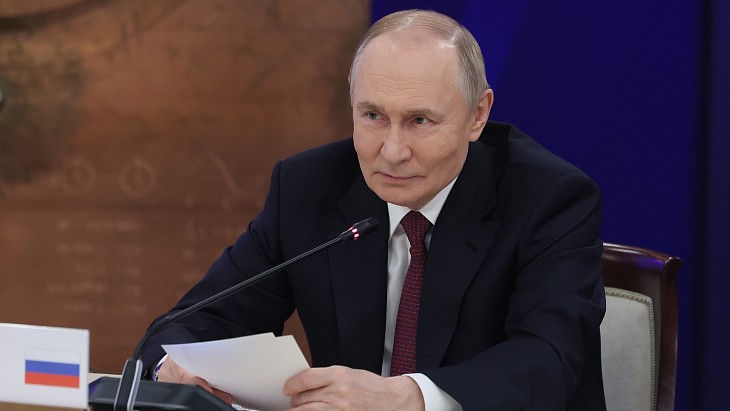
Speaking on the first day of the event, the president noted the projected increase in demand for new nuclear capacity in the coming decades and said “the growth in demand for peaceful nuclear energy will be driven largely by countries in the Global South and East, which are strengthening their technological and industrial potential”.
He said that Russia supported these countries’ ambitions, and said Russia rejected “so-called technological colonialism. We don’t make our partners dependent on Russian technical solutions. Instead, we help them create their own sovereign national nuclear industry, including training personnel and establishing centers of excellence”.
He said that it was “equal access to technology, including in the peaceful nuclear sector, that can ensure dynamic, yet equitable, and sustainable global development … we view peaceful nuclear technologies as a foundation for broad international cooperation and for bringing states closer together”.
The president also talked about finance, saying: “It is clear that the construction of nuclear power plants requires significant resources, which means the risks and benefits must be balanced among the main participants in such projects – states, investors, and consumers. I believe it is essential to develop modern models for financing the construction of nuclear power plants and to involve international financial institutions and development banks in such projects.
“I would like to add in this regard that earlier this year, the New Development Bank, created by the BRICS countries, confirmed its readiness to finance nuclear projects.” (BRICS is a multilateral organisation of emerging economies with current members being Brazil, Russia, India, China, South Africa, Egypt, Ethiopia, Iran, Indonesia, Saudi Arabia and the United Arab Emirates).
He referred to estimates that, in the very long term, uranium resources were finite, and said Russia aimed to “launch the world’s first nuclear energy system with a closed fuel cycle” in Tomsk, which would see 95% of used fuel reused repeatedly in reactors, thus helping solve the issues of radioactive waste and also of uranium resources.
The World Atomic Week International Forum, marking the 80th anniversary of the Russian nuclear industry, is taking place in Moscow from 25-28 September. A series of deals and announcements were made on the first day including:
-
Rosatom and the Beijing Research Institute of Uranium Geology signed an agreement providing access to, and exchange, of information on field testing at the Beishan Underground Research Laboratory, relating to the final disposal of high-level radioactive waste in underground repositories.
-
Rosatom and the Ethiopian Electric Power Corporation signed an action plan for developing a nuclear power plant project in Ethiopia. It creates a working group to prepare a roadmap for a feasibility study and intergovernmental agreement.
-
A contract was signed between Rosatom and the Belarusian Nuclear Power Plant Unitary Enterprise to cover the ‘blanaced nuclear fuel cycle’ at the Belarus plant – with Russian companies taking and reprocessing used fuel and Belarusian companies then accepting the reprocessed fuel.
-
Rosatom Technical Academy signed a memorandum of understanding with Myanmar’s Yangon Technological University, which provides for the development of “joint educational programmes, the exchange of curriculum and teaching materials, as well as joint research on advanced nuclear facilities and participation in international projects”.
-
Altynbek Rysbekov, Deputy Minister of Energy of Kyrgyzstan, said the country was working with Rosatom “to determine which areas could [be] suitable for a nuclear power plant and what capacity it should have”, according to the in-house Strana Rosatom publication.
-
Russia’s Rosatom and Iran’s Atomic Energy Organisation signed a memorandum of understanding for cooperation in the building of small modular reactors in Iran.
International Atomic Energy Agency Director General Rafael Mariano Grossi was among those attending World Atomic Week, and he also held talks with President Putin at the Kremlin, focusing on a range of issues including on-going safety concerns about the Zaporizhzhia and other nuclear power plants amid the war between Russia and Ukraine.
On financing, the IAEA leader proposed a memorandum of understanding between the agency and the BRICS’ New Development Bank. The organisation has arranged a similar partnership with the World Bank since it ended its longstanding ban on investing in nuclear energy-related projects.