The cryostat – into which some of the D-shaped toroidal field coils as well as PF1, the smallest of the ring-shaped poloidal field coils, will be inserted – is shaped “like a giant sardine box”, the ITER Organisation said. It measures 22 metres in length and almost 11 metres in width and weighs 330 tonnes.
Equipped with an 800-horsepower power pack, the convoy carrying the “highly exceptional load” arrived at ITER in the early hours of 4 October. The cryostat – the longest and widest component so far to be transported from the port to Cadarache – had travelled along the route over the previous five nights. No ITER convoy until now has taken more than four nights to travel the route.
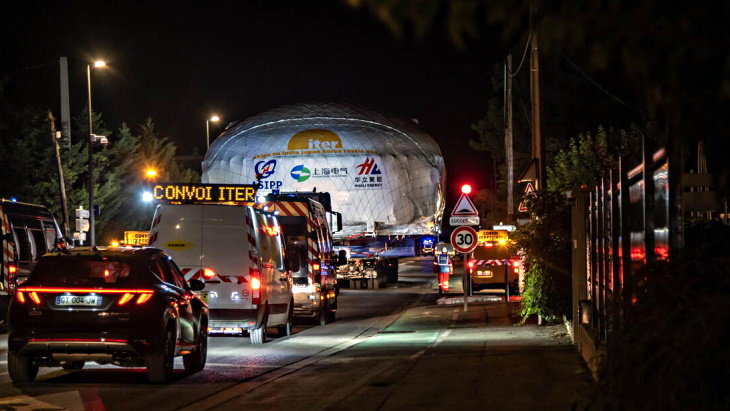
(Image: ITER Organisation)
ITER noted that as issues encountered with the vacuum vessel sectors and thermal shield piping interrupted the machine assembly sequence in 2022, “it became apparent that toroidal field coils would remain accessible long enough to allow for the creation of a cold test facility and the testing of some of the coils – ideally at least one per supplier – at 4 degrees kelvin (minus 269°C)”.
The contract for the customised cryostat was signed in December 2023 with a Chinese consortium that includes the Institute of Plasma Physics, Chinese Academy of Sciences (ASIPP), and Shanghai Electric Nuclear Power Equipment Company (SENPEC). The component was ready to ship earlier this year.
The cryostat for the test facility is now stored in the former Cryostat Workshop on site, where it will be equipped with reflective “super insulation” prior to its transfer to the magnet cold test facility where systems commissioning is ongoing. “The first elements of the facility are now connected to the cryoplant and they have been operating at 4 K since last Friday,” the ITER Organisation said.
The ITER project
ITER is a major international project to build a tokamak fusion device designed to prove the feasibility of fusion as a large-scale and carbon-free source of energy. The goal of ITER is to operate at 500 MW (for at least 400 seconds continuously) with 50 MW of plasma heating power input. It appears that an additional 300 MWe of electricity input may be required in operation. No electricity will be generated at ITER.
Thirty-five nations are collaborating to build ITER – the European Union is contributing almost half of the cost of its construction, while the other six members (China, India, Japan, South Korea, Russia and the USA) are contributing equally to the rest. Construction began in 2010 and the original 2018 first plasma target date was put back to 2025 by the ITER council in 2016. However, in June last year, a revamped project plan was announced which aims for “a scientifically and technically robust initial phase of operations, including deuterium-deuterium fusion operation in 2035 followed by full magnetic energy and plasma current operation”.