It appears that U.S. President Donald Trump’s strong support of the fossil fuel industry and his “energy dominance” agenda have provided Chevron – like its Big Oil peers – with a meaningful tailwind.
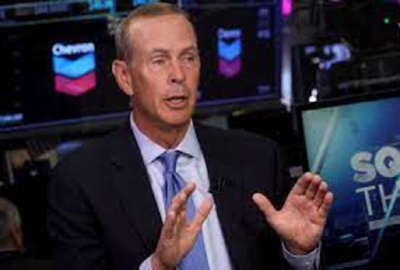
“Never in my career have I seen a higher confidence outlook,” Wirth told investors. “The best is yet to come.”
Get the Latest US Focused Energy News Delivered to You! It’s FREE:
Such confidence is striking when the U.S. Energy Information Administration expects oil prices to average $55 a barrel next year, down from $69 this year.
NEAR-TERM RETRENCHMENT
What a company says is one thing, though. What it does is far more important.
Oil and gas companies’ spending plans are a strong gauge for their near- and long-term risk appetite as many energy projects such as offshore oilfields or liquefied natural gas (LNG) plants require billions of dollars and years to develop, and many more years to generate returns.
It is therefore notable that Chevron is paring back its capital expenditures by $1 billion from previous guidance to a range of $18 billion to $21 billion per year into 2030.
The U.S.’s second-largest oil company also appears to be retrenching – albeit modestly – in the face of significant uncertainty over the supply and demand balance in the global oil market.
The International Energy Agency is currently forecasting a huge oversupply next year of 4 million barrels per day, around 4% of global supply, which, if accurate, could cause oil prices to crater.
Chevron’s minor pullback, however, suggests its thinking may be more aligned with OPEC analysts, who expect supply to roughly match demand next year, or others who believe any oversupply will be modest and short-lived.
LONG-TERM BOOM
Further out, Chevron’s actions seem to more closely match its messaging, as the company is clearly betting on continued growth in oil demand and a race to offset shrinking supplies.
Chevron plans to grow oil and gas production by 2% to 3% per year through 2030. It currently produces around 4 million barrels of oil equivalent per day.
“There is need for significant investment to close the oil supply gap, equivalent to five Saudi Arabias” over the next decade, Wirth said.
Crucially, Chevron noted it plans to keep production in the U.S. Permian shale basin stable at 1 million bpd through 2040 while also reducing investment to around $3.5 billion per year from $4.5 billion to $5 billion currently.
Chevron argues that improved drilling techniques will enable it to maintain production without having to drill new wells at the current pace – a fairly bold forecast given standard practices for shale oil drilling, also known as fracking.
Chevron is not the only big shale producer to indicate that it can profitably sustain and even grow shale production for many more years. Both ExxonMobil and ConocoPhillips suggest they can do the same, another indication of the industry’s growing confidence.
EXPLORATION BET
What perhaps best highlights Chevron’s long-term bullishness is its increasing investments in oil and gas exploration. This high-risk, high-reward business requires heavy investment, and it often takes over a decade or more to move from first drilling to the start of production.
In recent months, Chevron expanded its exploration activity in several basins including Namibia, Egypt and South America. The company plans to increase its annual exploration budget by 50% over the next few years. What’s more, it poached TotalEnergies’ exploration chief, Kevin McLachlan, in October to lead its exploration programme.
Does this mean we should expect a repeat of the start of this century, when huge, almost unimpeded investments in new oil and gas resources led to massive overspending and poor returns?
Probably not, as Big Oil companies are now hyper-focused on profitability and have instituted cost-saving practices that can allow them to generate profit even if oil prices hit $50 or below. Chevron aims to reduce structural costs by $3 billion to $4 billion by the end of 2026, including by laying off over 15% of its global workforce.
This spending discipline should enable Chevron and its peers to continue investing with greater confidence through peaks and troughs in the market over the coming years. That, in turn, also indicates that the market is apt to remain well supplied for the foreseeable future.
What is missing from all of this is a serious consideration of the energy transition. It is perhaps fitting that Chevron’s strategy update came on the day the IEA published a new long-term outlook that suggests oil demand may continue rising into 2050, having previously suggested it would begin to plateau in 2030.
This may be music to Big Oil’s ears, but if the energy transition picks up steam again – as many expect it will – Chevron and the rest of the industry could be in for a harsh reality check.
Want to receive my column in your inbox every Monday and Thursday, along with additional energy insights and links to trending stories? Sign up for my Power Up newsletter here. Enjoying this column? Check out Reuters Open Interest (ROI), your essential new source for global financial commentary. ROI delivers thought-provoking, data-driven analysis. Markets are moving faster than ever. ROI can help you keep up. Follow ROI on LinkedIn and X.
(By Ron Bousso; Editing by Tom Hogue)
Share This:
More News Articles