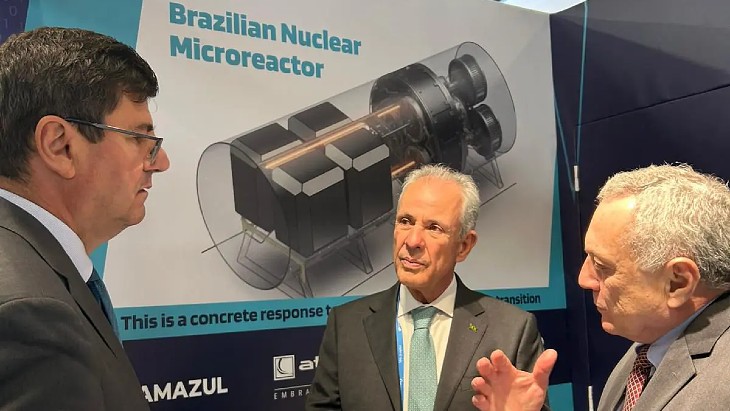
The National Nuclear Energy Commission (CNEN) project aims to demonstrate the feasibility of the development of a Brazilian 3-5 MW microreactor. The vision is for the microreactor to fit within a 40-foot container and be operated remotely for more than 10 years without any need for refuelling.
Earlier this year Industrias Nucleares do Brasil signed a contract with the Ministry of Science, Technology and Innovation and the Financing Agency for Studies and Projects for the development and testing of critical technologies applicable to Brazil’s planned microreactor.
The project also brings together research centres, universities and others, including the navy and the Institute of Energy and Nuclear Research and the Institute of Nuclear Engineering.
The microreactor project is headed by Diamante Energia, Núcleo Brasil Energia and Terminus, who presented the concept at World Nuclear Exhibition in Paris last week. They are aiming for the first units to be operational in eight to ten years.
They say that the project “contemplates the manufacture of new alloys using strategic and abundant materials in Brazil, such as uranium, beryllium and niobium, and the state of the art in manufacturing techniques by additive manufacturing”.
Industrias Nucleares do Brasil (INB) will be responsible for supplying nuclear fuel and specialised engineering services, as well as providing technical and administrative support.
In an update on progress, the National Nuclear Energy Commission said that one aspect to be defined is which fluid will be adopted for the heat pipes – saying that they are commonly “sodium (Na) or a eutectic alloy (sodium-potassium, NaK), due to its high thermal conductivity, low melting point, and wide operating range”.
It said two alternatives are being studied for the conversion of thermal energy into electrical energy: “(1) Closed Brayton cycle – the heat released by the heat pipe heats a pressurised gaseous fluid (usually helium (He) or carbon dioxide (CO₂) to the brink of boiling) in a heat exchanger. The hot gas expands in a microturbine, driving an electric generator. Then the gas is cooled and compressed again, closing the cycle” or “(2) Stirling cycle – heat from heat pipes heats a sealed cylinder containing gas (helium or hydrogen). The gas is cyclically heated and cooled, moving a piston that drives a linear electric generator. The system operates in a closed, silent, and combustion-free manner.”
Potential technical bottlenecks are listed as licensing, because existing regulations were designed for large plants, plus costs and scale, security and testing and validation of heat pipe cooling systems to ensure long-term reliability.
Positive technological developments are listed as passive safety systems, new fuels such as TRISO nuclear fuel, the enhanced abilities of advanced simulations and the wider benefits of collaborative work.
At the end of the three-year project it is proposed to demonstrate the main technologies planned, as well as seeking the first regulatory authorisations from Brazil’s regulators.
Suggested future uses for the microreactor include providing reliable power to remote towns, to hospitals and factories and reducing dependency on diesel generators. In March the commission said: “The project is currently at the TRL 3 technological readiness level, which corresponds to the mathematical modeling and preliminary studies phase. The goal is to advance to TRL 6, the level at which the technology is demonstrated in a relevant environment, closer to practical application.”
There are various microreactor projects at different stages of development around the world. While small modular reactors are generally seen as including reactors up to 300 MW, microreactors are said by the International Atomic Energy Agency to be those designed for up to about 20 MW, with container-based ones seen as especially having the ability to be transported to a wide range of potential locations, including isolated areas.
IEN/CNEN researcher Maria de Lourdes Moreira said: “Aligned with the current government’s policy of reindustrialisation and technological sovereignty, the microreactor symbolises a new stage in Brazilian energy innovation – sustainable, strategic, and fully national.”
Brazil currently has two operating power reactors – Angra 1 and Angra 2 – which generate about 3% of the country’s electricity. Work on the Angra 3 project – to feature a Siemens/KWU 1405 MW pressurised water reactor – began in 1984 but was suspended two years later, before construction began. The scheme was resurrected in 2006, with first concrete in 2010. However, amid a corruption probe into government contracts, construction of the unit was halted for a second time in 2015, when it was 65% complete. It has since restarted and been halted again, with a decision currently awaited on completing it.