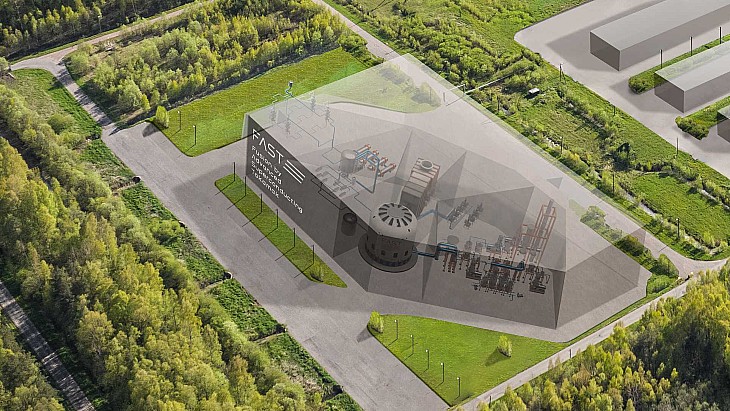
The Conceptual Design Report has been put together in the year since the project’s launch in November 2024, and involved the two companies and researchers and experts from a number of Japanese universities and public institutions, as well as support from a number of other Japanese companies.
The Fusion by Advanced Superconducting Tokamak (FAST) device, to be sited in Japan, aims to generate and sustain a plasma of deuterium-tritium (D-T) reactions, demonstrating an integrated fusion energy system that combines energy conversion including electricity generation and fuel technologies. The project will employ a tokamak configuration, chosen for its well-established data and scalability.
Targeting a power generation demonstration by the end of the 2030s, FAST will address remaining technical challenges en route to commercial fusion power plants. The FAST Project Office notes that power generation refers to producing energy from fusion reactions, but does not imply net positive power production where electricity output exceeds electricity consumption.
The project team said the conceptual design work involved “designing the fusion energy plant for power generation demonstration, assessing technical and engineering feasibility, clarifying the project direction, conducting safety and economic evaluations, and defining the plant’s fundamental design specifications”.
“With the completion of the conceptual design phase, the project will now shift to engineering design, accelerated engineering R&D, and will proceed with site selection, site preparation, regulatory approvals, and the procurement of long-lead items, with the aim of construction after 2028,” it said.
Kiyoshi Seko, CEO of Starlight Engine Ltd and President and COO of Kyoto Fusioneering Ltd, said: “Completing the conceptual design in just one year is a result of Japan’s decades of research achievement. FAST is now moving into the engineering design phase. We will harness the strength of Japan’s manufacturing industry and accelerate the project with a sense of urgency.”
Satoshi Konishi, co-founder and CEO of Kyoto Fusioneering, said: “First and foremost, it’s a great achievement to complete the conceptual design activities within the planned one-year timeframe. We succeeded in creating an innovative design that incorporates new technologies essential for commercial plants, such as high-temperature superconducting magnets, liquid breeding blanket systems, and highly efficient tritium fuel cycle systems, by mobilising domestic experts. Preparations for safety design, regulatory approvals, and site selection are steadily progressing. In the next engineering design phase we expect to fully leverage our strengths in plant engineering and our broad network across diverse industries, including finance and construction.”
Kenzo Ibano, Assistant Professor, Osaka University, said: “Thanks to the power of industry-academia collaboration, we have successfully produced Japan’s first CDR for a power generation demonstration project. Working alongside researchers with decades of experience and private-sector partners in driving this project forward is both stimulating and rewarding, giving a strong sense of mission.”
The Conceptual Design Report is due to be presented at the 42nd Annual Meeting of the Japan Society of Plasma Science and Nuclear Fusion Research being held from 1 December.
Other academics and businesses participating in and supporting the FAST project include Professor Akira Ejiri, University of Tokyo and Professor Takaaki Fujita, Nagoya University, as well as Sumitomo Mitsui Banking Corporation, Electric Power Development (J-Power), JGC JAPAN Corporation, Hitachi, Fujikura, Furukawa Electric, Marubeni Corporation, Kajima Corporation, Kyocera, Mitsui & Co., Mitsui Fudosan, and Mitsubishi Corporation.