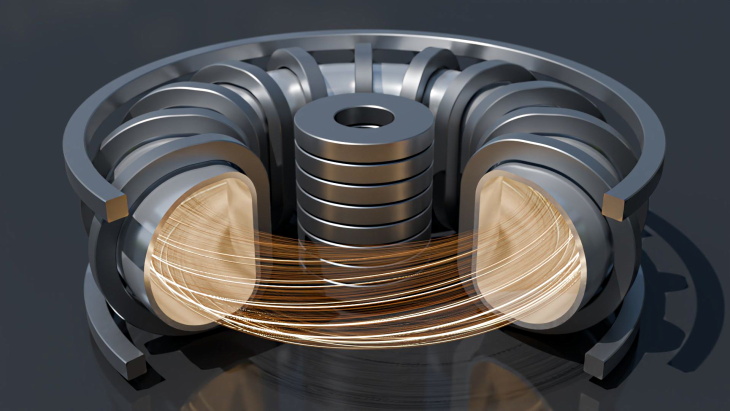
Magnetic nuclear fusion is considered a promising technology for sustainable and emission-free energy supply. However, to achieve fusion, machines need to confine plasma at extreme temperatures using powerful magnets. Managing turbulence within the plasma is a key fusion challenge so it needs to be accurately modelled.
Plasma scientists rely on state-of-the-art numerical simulations, using five-dimensional (5D) gyrokinetics, which includes three spatial dimensions plus two additional dimensions which account for parallel and perpendicular velocity of particles within the plasma. This 5D approach requires immense supercomputing power. Traditional simulations are extremely slow and computationally expensive, significantly lengthening design and development cycles. Previously, computation methods simulated a plasma by actively calculating the complex plasma dynamics.
GyroSwin uses the latest AI methods to learn the 5D simulation dynamics and the resulting surrogate models can run in seconds, in contrast to the hours or even days for conventional simulations. It was trained on six terabytes of data. This speed allows for much faster, more agile prediction of plasma turbulence, crucial for optimising fusion machine designs.
“Designing, developing, and operating a fusion power plant will involve millions of plasma simulations,” said Rob Akers, Director of Computing Programmes at UKAEA. “Reducing runtimes from hours or days to minutes or seconds – whilst preserving sufficient accuracy – will be essential for making this challenge manageable. Pioneering AI-based tools like GyroSwin therefore show great promise for being genuinely transformative around time-to-solution and cost.”
Processing 5D data has never previously been tackled by an AI surrogate model, and GyroSwin outperforms other AI methods it’s been compared against, UKAEA noted. This increased performance is made possible because GyroSwin preserves key physical information from a fusion plasma, including the length scale of fluctuations, and the sheared flows that can reduce turbulence – all crucial to the physical interpretability of plasma simulations.
“We love scientific challenges, and building AI models that accelerate 5D gyrokinetic simulations is definitely one of the toughest challenges out there,” said Johannes Brandstetter, Professor at JKU, co-founder and Chief Scientist at Emmi. “We are very proud of how far we got in this great collaboration, but we know that we have just scratched the surface.”
UKAEA will now research how GyroSwin’s advanced capability can be applied to next generation power plants such as the UK’s Spherical Tokamak for Energy Production (STEP), where millions of simulations will potentially be required to optimise plasma scenario designs with uncertainty quantification. As more complex physics is included for power plant conditions, simulations become even more lengthy, making faster plasma modelling essential.
This GyroSwin project was part-funded by the International Computing element of the UK Government’s Fusion Futures Programme.