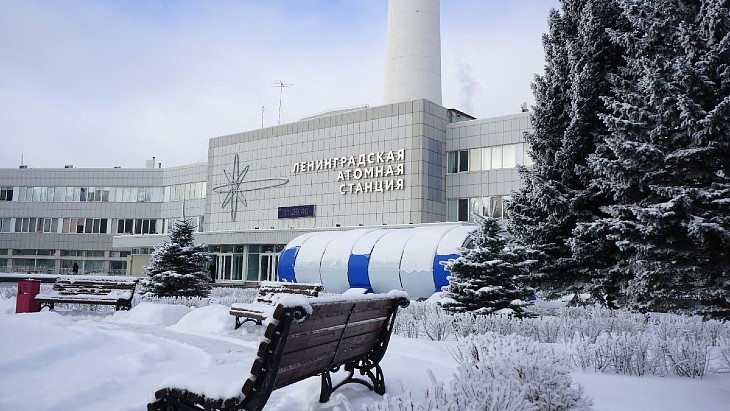
Leningrad 4 given five-year life extension licence

The licence approval followed what it called a comprehensive analysis and inspection of equipment and documentation “to ensure compliance with modern safety and reliability requirements” and “the completion of modernisation and replacement measures for components that have reached the end of their service life”.

Vladimir Pereguda, plant director, said: “Work to extend the service life of existing power units at Russian nuclear power plants has been under way since 1998. Our units are no exception. This extended service life means more than just electricity generation. It also means jobs, continued production of unique isotope products, and the planned construction and commissioning of two new VVER-1200 units.”

Rostekhnadzor has also issued a licence for handling radioactive substances relating to the production of isotope products at the unit until 2030. The plant currently has the capacity to produce molybdenum-99, iodine-125, iodine-131, samarium-153, and lutetium-177, which are used in medical diagnosis and treatment.

Leningrad unit 4 was launched in 1981 with an initial service life of 30 years. Following earlier modernisation work its service life was extended by 15 years to 2026. Rosatom said it has generated about 300 billion kWh of electricity so far.

The Leningrad plant is one of the largest in Russia, with an installed capacity of 4,400 MWe, and provides more than 55% of the electricity demand of St Petersburg and the Leningrad region, or 30% of all the electricity in northwest Russia.

Leningrad units 1 and 2 – both 1000 MWe RBMK units – shut down in 2018 and 2020, respectively. Unit three was granted a five-year life extension in February 2025.

As the first two of the plant’s four RBMK-1000 units shut down, new VVER-1200 units started at the neighbouring Leningrad II plant. The 60-year service life of these fifth and sixth units (also known as Leningrad II-1 and Leningrad II-2) secures power supply until the 2080s. Units 7 and 8 – scheduled to be commissioned in 2030 and 2032, respectively – will replace units 3 and 4 as they get to the end of their operational life.
   

  • Related Posts

    Deep Isolation launches full-scale demonstration programme

    A groundbreaking event was held on 28 January to mark the beginning of the demonstration project, which is aimed at building stakeholder and regulatory confidence in the company’s deep borehole…

    WANO rolls out new enhanced monitoring initiative

    World Association of Nuclear Operators (WANO), which has traditionally focused on peer review visits to nuclear units every four years, is now also getting key data from each of the…

    Have You Seen?

    Libya Signals a New Gas Push as Europe Searches for Supply

    • February 3, 2026
    Libya Signals a New Gas Push as Europe Searches for Supply

    Ørsted to Sell European Onshore Business for $1.7 Billion

    • February 3, 2026
    Ørsted to Sell European Onshore Business for $1.7 Billion

    Kuwait Seeks Foreign Majors’ Help to Develop Offshore Fields

    • February 3, 2026
    Kuwait Seeks Foreign Majors’ Help to Develop Offshore Fields

    Qatar Moves to Reclaim Japan’s LNG Market With Major Jera Deal

    • February 3, 2026
    Qatar Moves to Reclaim Japan’s LNG Market With Major Jera Deal

    Devon, Coterra Sign ‘Blockbuster’ Merger Deal

    • February 3, 2026
    Devon, Coterra Sign ‘Blockbuster’ Merger Deal

    EU set outs carbon removal standards for DACCS and BioCCS

    • February 3, 2026
    EU set outs carbon removal standards for DACCS and BioCCS

    Oil Steadies as Investors Weigh Supply, Possible US-Iran de-Escalation

    • February 3, 2026
    Oil Steadies as Investors Weigh Supply, Possible US-Iran de-Escalation

    COMMENTARY: A $47 Bln Deal Heralds US Oil Boom’s Middle Age

    • February 3, 2026
    COMMENTARY: A $47 Bln Deal Heralds US Oil Boom’s Middle Age

    Marathon Petroleum Profit Beats as Margins Rebound From Multi-Year Lows

    • February 3, 2026
    Marathon Petroleum Profit Beats as Margins Rebound From Multi-Year Lows

    US-Driven Gas Turbine Crunch May Speed Global Clean Power Uptake

    • February 3, 2026
    US-Driven Gas Turbine Crunch May Speed Global Clean Power Uptake