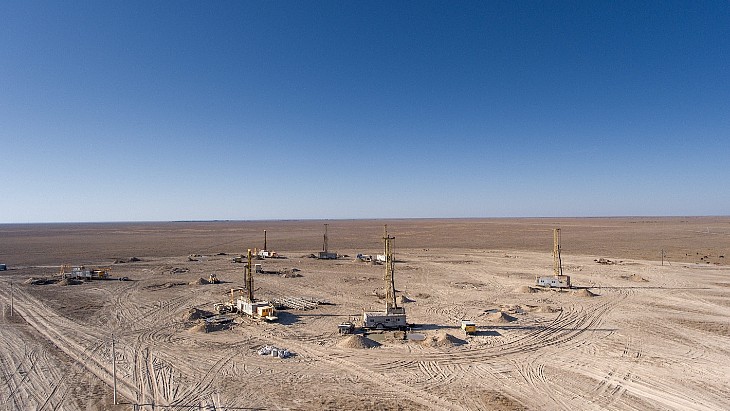
Canada-based uranium exploration and development company Laramide said it has terminated its option agreement with Kazakhstan-registered Aral Resources for the Chu-Sarysu Project with immediate effect. The three-year agreement, signed in 2024, had given Laramide exploration access to over 5,500 square kilometres of the prolific Chu-Sarysu Basin, and Laramide said it has been funding greenfield exploration programmes to identify the highest priority initial drilling targets for uranium mineralisation since then.
Last September – having compiled a large dataset from Kazakhstan’s state National Geological Services with assistance from local geological contractors – the company was planning to begin a 15,000 metre drilling programme. Drilling had been slated to begin in the final quarter of the year, but unexpected delays in receiving necessary work permits from the regional government meant that no drilling commenced.
The final permits needed for the initial programme were received on 24 December. However, two days later, a series of amendments to Kazakhstan’s Subsoil Use legislation were formalised by the country’s president – changes which Laramide said have “dramatically” reduced the potential for companies other than Kazakhstan’s national atomic company Kazatomprom to participate in greenfield uranium exploration.
“As a result of these sweeping changes to prospective Subsoil Use Agreements, which also followed an approximate doubling of cash holding costs for annual property taxes earlier in 2025, Laramide believes an economic case for foreign direct investment in uranium exploration no longer exists in Kazakhstan,” the company said. “Accordingly, Laramide has terminated the Option Agreement with immediate effect and has ceased funding any further exploration activities.”
The company said it will focus on developing its two large development-stage uranium assets at Churchrock-Crownpoint in New Mexico, USA and Westmoreland in Queensland, Australia.
Legal changes
Kazakhstan produces more than 40% of the world’s uranium, all using in-situ mining methods (known as in-situ leach, ISL, or in-situ recovery, ISR), with uranium-bearing minerals being dissolved and recovered via wells. The replenishment and efficient use of the uranium resource base is a key focus of Kazatomprom’s long-term development strategy.
Subsoil use contracts are agreements with the Kazakh government covering the production of uranium by ISL methods. The amendments to the country’s Subsoil and Subsoil Use Code approved by the Senate late last year include restrictions ensuring Kazatomprom takes a 75% interest in any legal entity to which it transfers a subsoil use contract.
Laramide President and CEO Marc Henderson said the amendments had been “motivated by an effort to address, and ideally reverse, the obvious and severe decline in the resource base of Kazatomprom” that amounted to a “de facto nationalisation of future uranium exploration in country”, a move he said was a “spectacular own goal”.
“Kazatomprom faces a huge resource renewal challenge but so does the entire industry, which is really the read through from this unfortunate geopolitical development,” he said, adding that greenfield exploration in the uranium sector “appears to be woefully under invested”, and uranium prices may need “to go higher – perhaps much higher in our view – to incentivise and catalyse the reserve replacement activity that is clearly required to resolve the large and growing supply deficit”.
Responding to media coverage of Laramide’s announcement, Kazatomprom said it “does not have, and has never had, any joint ventures, contractual relationships, or projects neither with Laramide Resources Ltd nor Aral Resources Ltd”.
“Kazatomprom is not a participant in the uranium exploration projects mentioned in the material and does not comment on commercial decisions or statements made by companies with which it has no partnership or contractual relations,” it said.
The exploration licences held by Aral Resources were issued for solid minerals and did not confer exclusive rights to potential uranium resources, it noted, adding that historically, Kazatomprom “has held a priority right to uranium production in the Republic of Kazakhstan. Accordingly, when third parties initiate uranium exploration activities, such subsoil users are aware of the regulatory limitations related to any potential transition to uranium mining.
“Uranium exploration in Kazakhstan is a complex, multi-stage process that requires advanced technological expertise and strict compliance with legislation of the Republic of Kazakhstan.”
Kazatomprom “continuously works to replenish its uranium resource base, demonstrating sustainable growth in uranium reserves and expanding the areas under exploration” and has over the past three years “significantly expanded its portfolio of new geological exploration projects, upon the completion of which the identification of additional uranium resources and reserves is expected in substantial quantities sufficient for decades to come. Subsoil use rights to these prospective sites belong exclusively to Kazatomprom”, it said.