

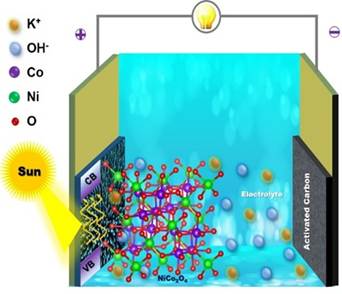
Scientists at the Centre for Nano and Soft Matter Sciences (CeNS), Bengaluru, have developed an innovative photo-rechargeable supercapacitor—a single device that can capture solar energy and store it simultaneously, eliminating the need for separate solar panels and batteries.
Dubbed a photo-capacitor, the technology represents a major step toward compact, low-cost, and self-sustaining power systems for applications such as portable electronics, wearables, IoT devices, and off-grid technologies.
Conventional solar energy systems rely on two distinct components: photovoltaic panels to harvest energy and batteries or supercapacitors to store it. This setup requires additional power management electronics to balance voltage and current differences—adding complexity, cost, energy loss, and bulk.
The new device overcomes these limitations by integrating energy harvesting and storage into a single architecture, reducing system footprint while improving efficiency.
Led by Dr. Kavita Pandey, the research team engineered binder-free nickel-cobalt oxide (NiCo₂O₄) nanowires, grown directly on nickel foam through a simple in situ hydrothermal process. These ultra-thin nanowires form a highly porous, conductive 3D network that efficiently absorbs sunlight while storing electrical charge.
This unique structure enables the material to act both as a solar absorber and a supercapacitor electrode.
Under illumination, the NiCo₂O₄ electrode demonstrated a 54% increase in capacitance, rising from 570 to 880 mF cm⁻² at a current density of 15 mA cm⁻². Even after 10,000 charge–discharge cycles, it retained 85% of its original capacity, indicating excellent durability.
An asymmetric prototype device—using activated carbon as the negative electrode—delivered a stable 1.2 V output and maintained 88% capacitance retention after 1,000 photo-charging cycles, operating reliably under light conditions ranging from indoor illumination to intense sunlight.
Theoretical simulations revealed that nickel substitution in cobalt oxide narrows the band gap to ~1.67 eV and induces half-metallic behavior—a rare property that enhances charge transport and electrical conductivity. This spin-dependent conductivity supports faster, more efficient photo-assisted energy storage, explaining the system’s exceptional performance.
Published in Sustainable Energy & Fuels (Royal Society of Chemistry), the research introduces a new generation of smart, light-responsive energy storage devices that could significantly reduce reliance on fossil fuels and conventional batteries.
By merging solar harvesting and energy storage into a single compact unit, this breakthrough could reshape renewable energy system design, enable self-powered electronics, and support India’s clean energy ambitions—while inspiring next-generation energy innovations globally.
This development marks a paradigm shift in sustainable energy storage, bringing the vision of truly self-charging devices closer to reality.
Subscribe to get the latest posts sent to your email.













)