A groundbreaking event was held on 28 January to mark the beginning of the demonstration project, which is aimed at building stakeholder and regulatory confidence in the company’s deep borehole disposal technology. The demonstration programme – which does not utilise radioactive material – will provide crucial data and operational experience to further the commercialisation strategy for Deep Isolation’s deep borehole disposal technology. Deep Isolation is carrying out the programme in collaboration with the Deep Borehole Demonstration Center (DBDC), Halliburton, Amentum, NAC International, and Occlusion Nuclear Solutions.
The event was held at the DBDC facility, located at the Halliburton Drilling Technology Facility near Cameron, Texas, and brought together project partners and key stakeholders from across the nuclear industry, the US Department of Energy, and officials from the State of Texas, Milam County, and City of Cameron.
“The groundbreaking marks the start of a historic programme that will allow us to advance on the path to the commercialisation of our deep borehole disposal technology and Universal Canister System,” said Deep Isolation President and CEO Rod Baltzer. “We are thrilled to have brought together this extensive collaboration of leading organisations in nuclear technology, drilling services, and waste management to address one of the nuclear industry’s most pressing challenges: developing a safe and permanent solution for nuclear waste disposal. We believe our technology, once commercialised, has the potential to revolutionise the nuclear industry with a long-term solution for disposing of spent nuclear fuel.”
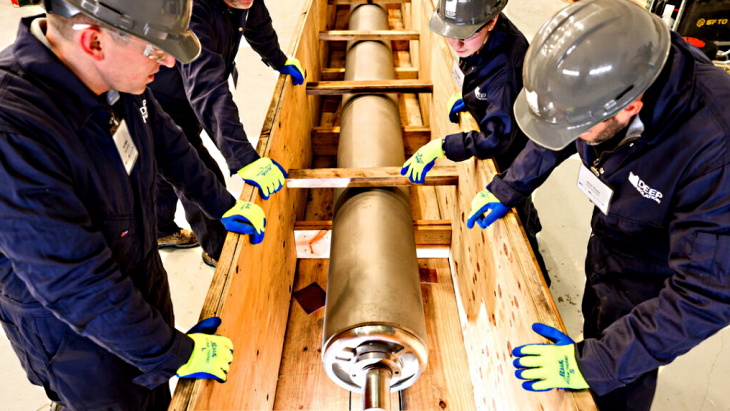
Unboxing the universal canister system at the groundbreaking ceremony (Image: Deep Isolation)
Disposal in deep boreholes – narrow, vertical holes drilled deep into the earth’s crust – has been considered as an option for the geological isolation of radioactive wastes since the 1950s. Deep borehole concepts have been developed in countries including Denmark, Sweden, Switzerland, and the USA but have not yet been implemented.
Deep Isolation’s patented technology leverages standard drilling technology using off-the-shelf tools and equipment that are common in the oil and gas drilling industry. It envisages emplacing nuclear waste in corrosion-resistant canisters – typically 9-13 inches (22-33 centimetres) in diameter and 14 feet long – into drillholes in rock that has been stable for tens to hundreds of millions of years. The drillhole – which is lined with a steel casing – begins with a vertical access section which then gradually curves until it is nearly horizontal, with a slight upward tilt. This horizontal ‘disposal section’ would be up to two miles (3.2 kilometres) in length and lie anything from a few thousand feet to two miles beneath the surface, depending on geology. Once the waste is in place, the vertical access section of the drillhole and the beginning of its horizontal disposal section would be sealed using rock, bentonite and other materials.
Deep Isolation’s Universal Canister System (UCS) – developed in collaboration with NAC International Inc through a three-year project funded by the US Department of Energy (DOE) Advanced Research Projects Agency–Energy (ARPA-E) – is designed to accommodate a range of advanced reactor waste streams, including vitrified waste from reprocessing, TRISO used fuel, and halide salts from molten salt reactors. It is compatible with modern dry storage and transport infrastructure, and meets performance and safety requirements across both borehole and mined repository options, which gives greater flexibility and reduced uncertainty in future waste disposition, the company says.
Last month, Deep Isolation said that a two-year research project funded by the DOE’s ARPA-E that subjected its UCS to the kinds of conditions found thousands of feet below the surface had shown materials used in its fabrication perform reliably and remain resistant to corrosion over time.