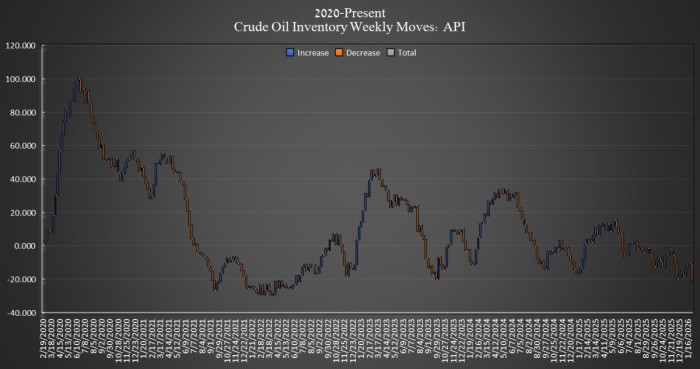
The American Petroleum Institute (API) estimated that crude oil inventories in the United States decreased by 11.1 million barrels in the week ending January 30. Crude oil inventories decreased by 247,000 barrels in the week prior.
Inventories in the US Strategic Petroleum Reserve (SPR) keep climbing week after week. The Department of Energy (DoE) reported that crude oil inventories in the SPR rose by 200,000 barrels to 415.2 million barrels in the week ending January 30. This is 310.3 million barrels shy of maximum capacity.
US production fell for the fourth week in a row during the week of January 23 to 13.696 million bpd, down from 13.732 million bpd in the week prior, according to the latest EIA data. This is 456,000 bpd more than this same time last year.
At 3:54 pm ET, Brent crude was trading up on the day at $68.10 (+2.71%). Brent is now roughly $0.70 per barrel up from this time last week as tensions in the Middle East persist. WTI was also trading up on the day, by $1.89 (+3.04%) at $64.03.
Gasoline inventories rose this week, gaining 4.7 million barrels in the week ending January 30. In the week prior, gasoline inventories fell by 415,000 barrels. As of last week, gasoline inventories were 5% above the five-year average for this time of year, according to the latest EIA data.
Distillate inventories fell in the reporting period by 4.8 million barrels, after gaining 2 million barrels in the week prior. Distillate inventories were 1% above the five-year average as of the week ending January 23, the latest EIA data shows.
Cushing inventory—the inventory kept at the delivery hub for the WTI Crude futures contract—fell by 1.4 million barrels, after decreasing by 92,000 barrels in the prior week.
By Julianne Geiger for Oilprice.com
More Top Reads From Oilprice.com
- Oil Tanker Rates Soar Amid Shipping Shortages and Middle East Tensions
- Kuwait Seeks Foreign Majors’ Help to Develop Offshore Fields
- BP Shareholders Demand Proof That Fossil Fuel Pivot Will Pay