India’s Rajasthan unit 7 reaches full power

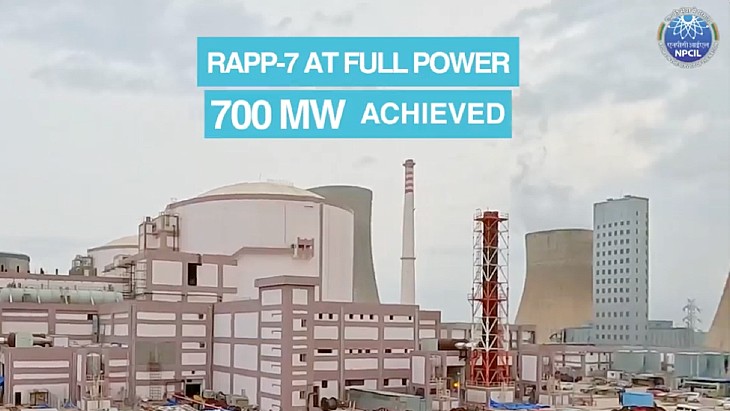
Nuclear Power Corporation of India Limited (NPCIL) announced on LinkedIn: “Rajasthan Atomic Power Project – Unit-7 (RAPP-7) successfully achieved rated power operation of 700 MW for the first time on 10 February 2026 at 05.15 hrs.

“The milestone stands as a testament to engineering excellence, strong teamwork and institutional synergy, reinforcing NPCIL’s role in strengthening India’s clean, reliable and self-reliant energy future. A proud moment for NPCIL, powering India with confidence and excellence.”

The company said that the achievement “establishes the robustness of the NPCIL’s 700 MW PHWR design and the capabilities of NPCIL and Indian industries”.

Unit 7 reached first criticality in September 2024 and was connected to the grid in March 2025. Once a new unit has been connected to the grid, it undergoes a process known as power ascension testing when its power levels are gradually raised – under approval from the regulator – until it reaches full capacity, as unit 7 did on Tuesday.

The unit follows Kakrapar 3 and 4 in a planned fleet of 700 MWe PHWRs: unit 3 achieved first criticality in July 2020, was connected to the grid in January 2021 and was declared to be in commercial operation in July 2023. Unit 4, which reached first criticality in December 2023, was connected to the grid in February 2024 and entered commercial operation in March 2024.

A second 700 MWe unit, RAPP-8, is also under construction at the Rajasthan site at Rawatbhata, which is already home to six operating PHWRs with a total capacity of 1,180 MW. NPCIL said light water commissioning of the eighth unit is in progress.

India’s government has sanctioned the “fleet mode” construction of further 700 MWe units at Kaiga in Karnataka; Gorakhpur in Haryana; Chutka in Madhya Pradesh; and Mahi Banswara in Rajasthan. India’s ambition is to have at least 100 GW of nuclear energy capacity by 2047 to support its energy transition efforts.
   

  • Related Posts

    Eagles and Newcleo team up for LFR technology demonstrator

    Four European nuclear technology organisations launched the Eagles Consortium in June last year to develop and commercialise the EAGLES-300 small modular reactor (SMR) with the aim of delivering a first…

    Cold testing of third Sanmen unit completed

    Such tests are carried out to confirm whether components and systems important to safety are properly installed and ready to operate in a cold condition. The main purpose of cold…

    Have You Seen?

    Big Oil Courts Syria for Major Exploration Deals

    • February 11, 2026
    Big Oil Courts Syria for Major Exploration Deals

    Indian Refiners Urged to Buy More U.S. and Venezuela Oil

    • February 11, 2026
    Indian Refiners Urged to Buy More U.S. and Venezuela Oil

    OPEC Data Indicate Small Q2 Surplus Ahead of Key OPEC+ Decision on Resuming Oil Output Hikes

    • February 11, 2026
    OPEC Data Indicate Small Q2 Surplus Ahead of Key OPEC+ Decision on Resuming Oil Output Hikes

    Trump Allows U.S. Firms to Provide Services for Venezuela’s Oil

    • February 11, 2026
    Trump Allows U.S. Firms to Provide Services for Venezuela’s Oil

    TotalEnergies Q4 Profit Slips on Lower Oil Prices

    • February 11, 2026
    TotalEnergies Q4 Profit Slips on Lower Oil Prices

    Novatek’s 2025 Profit Tumbles 60% as Sanctions Bite

    • February 11, 2026
    Novatek’s 2025 Profit Tumbles 60% as Sanctions Bite

    EIA Sees Brent Price Dropping in 2026 and 2027

    • February 11, 2026
    EIA Sees Brent Price Dropping in 2026 and 2027

    US Energy Secretary Set to arrive in Venezuela with Herculean Task of Oil Recovery

    • February 11, 2026
    US Energy Secretary Set to arrive in Venezuela with Herculean Task of Oil Recovery

    TotalEnergies Seizes Full Control of Lukoil Refinery in Netherlands

    • February 11, 2026
    TotalEnergies Seizes Full Control of Lukoil Refinery in Netherlands

    Trump to Order Pentagon to Buy Coal Power for National Security

    • February 11, 2026
    Trump to Order Pentagon to Buy Coal Power for National Security