By and
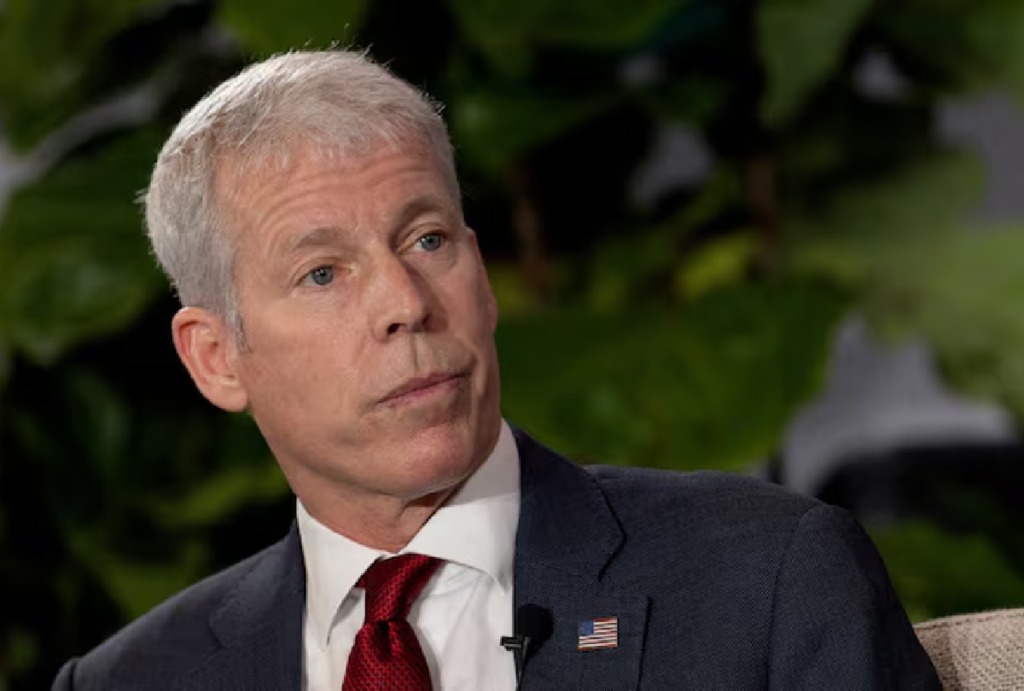
- US Energy Secretary Chris Wright met Venezuelan interim President Delcy Rodriguez
- Visit follows Maduro’s capture, $2 billion oil supply deal
- US aims to reshape global energy markets and pressure Russia, analyst says
HOUSTON, Feb 11 (Reuters) – Venezuela is hosting U.S. Secretary of Energy Chris Wright this week, marking the highest-level U.S. visit focused on energy policy to theOPEC nation in nearly three decades, as Washington conducts its first on-the-ground assessment of the oil industry it is proposing to rebuild.
Get the Latest US Focused Energy News Delivered to You! It’s FREE:
Wright landed in Caracas on Wednesday, a day after the U.S. issued a new general license to facilitate the exploration and production of oil and gas in Venezuela, and met interim President and Oil Minister Delcy Rodriguez at the Miraflores presidential palace.
They would discuss a bilateral energy agenda, Venezuela information minister Miguel Perez Pirela said in a release posted on social media at the beginning of the meeting.
Wright is also scheduled to meet executives from companies including Chevron (CVX.N) and Spain’s Repsol (REP.MC). He is expected to stay through Friday and meet with local consumer goods companies before visiting Petropiar, the largest oil project
Chevron and state energy company PDVSA operate, in Venezuela’s main oil region, the Orinoco Belt, sources familiar with the preparations said.
The trip follows the capture of President Nicolas Maduro by U.S. forces in early January, a $2 billion oil supply deal agreed to by the U.S. and Venezuela shortly after, and a $100 billion reconstruction plan for the country’s energy industry promoted by President Donald Trump.
The U.S. embassy in Caracas, which began reopening in late January, said Wright’s visit would be key to advancing Trump’s vision for Venezuela.
“The U.S. private sector will be essential to boost the oil sector, modernize the electric grid, and unlock Venezuela’s enormous potential,” Charge d’Affaires Laura Dogu wrote in a post on X. She also attended the meeting in Miraflores.
The last U.S. energy secretary to travel to Venezuela was Bill Richardson, who made several trips between 1998 and 2001 under former President Bill Clinton. Visits to Caracas by high-ranking U.S. officials have been virtually nonexistent since, as the bilateral relationship with former President Hugo Chavez and then Maduro was strained.
WHAT WRIGHT WILL FIND IN VENEZUELA
Wright and Rodriguez face the Herculean task of organizing the recovery of Venezuela’s oil industry after decades of underinvestment, mismanagement and U.S. sanctions, while putting U.S. investors at the front of the line. Wright will face a political context that is still volatile after a
high-profile opposition leader was released from jail this week, only to be re-arrested hours later.
Wright’s visit reflects a longer-term U.S. geostrategic interest in Venezuelan oil as Washington seeks to reshape global energy markets while pressuring Russia, according to Thomas O’Donnell, an analyst who specializes in energy geopolitics.
The Trump administration has moved beyond detaching Venezuela from Russian and Chinese influence to pursuing a “doctrine of American energy dominance” that could provide the U.S. capacity to eventually take Russian oil offline if geopolitically required, he said.
“This is an active geostrategic, geo-economic plan to use American oil abundance and cooperation with the Saudis and the United Arab Emirates and other Gulf States and Venezuela and Guyana to reshape the global oil market,” he added.
Venezuela’s National Assembly last month approved a sweeping reform to the country’s primary oil law, which grants operational and financial autonomy to foreign producers as a first step to encourage investment.
Senator John Hickenlooper, a Democrat from energy-producing Colorado, told reporters on Tuesday after a classified briefing by Wright that “the whole thing … is like doing an impossibly difficult high dive, or an impossibly difficult freestyle skiing flip maneuver. All we can do is hope that it succeeds.”
Reporting by Marianna Parraga, Nathan Crooks, Sheila Dang, Timothy Gradner and Reuters staff; Editing by Chris Reese and Mark Porter
Share This:
More News Articles