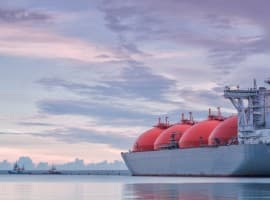
A tanker carrying liquefied gas is sailing to Europe from China in a rare move that was last made four years ago.
The Seapeak Glasgow loaded the liquefied gas at the Zhejiang Ningbo terminal, Bloomberg reported, citing tanker-tracking data, and is signaling Europe as its next destination. European LNG imports are running at record highs amid a seasonal peak in demand.
Earlier this month, Bloomberg reported that U.S. and Russian liquefied gas together accounted for over 80% of Europe’s seaborne gas imports. The U.S. share of that was 55% and Russian LNG accounted for mover 25%. That latter LNG will disappear from next year as the EU approved a complete ban on Russian gas imports earlier this year. As things stand now, the European Union is the largest buyer of Russian liquefied gas, absorbing half of the country’s total LNG output.
Despite record LNG imports, European countries are digging deeper into their gas storage, with EU-wide levels at just 35.62% full as of February 10th. In France, the level of gas in storage was even lower, at 26.09%, and in Germany it was 25.60%, according to Gas Infrastructure Europe.
China, meanwhile, has been filling its own gas storage, with demand for LNG weakening throughout 25, except the final two months of the year when seasonal demand caused a spike in imports. Thanks to ample supply, China is in a position to resell LNG, including to a destination as distant as Europe.
Europe is expected to import a record-high volume of liquefied natural gas this year as stronger demand for replenishing storage sites, the phase-out of Russian supply, and continued pipeline exports to Ukraine will drive increased demand, the International Energy Agency said earlier this year. Meanwhile, two gas storage sites in Germany are about to be shut down, as their operators told the German government they are no longer profitable.
By Irina Slav for Oilprice.com
More Top Reads From Oilprice.com
- Saudi Arabia’s Aramco Begins Production At $100B Jafurah Gas Project
- U.S. Energy Secretary Says Venezuela Could See Surge in Oil Output
- EU Industry Chiefs Demand Lower Energy Prices