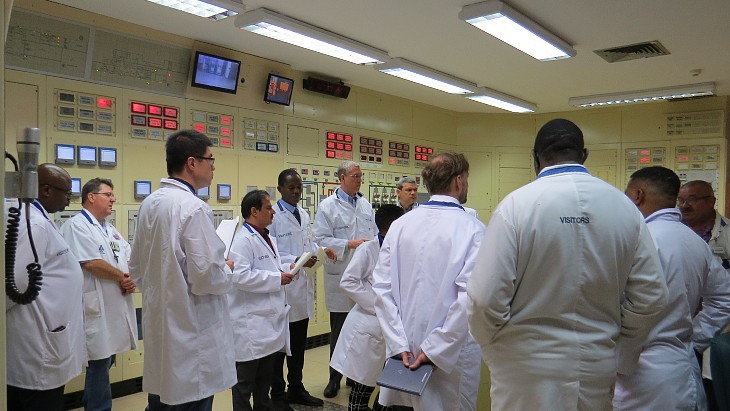
The five-day six-person Safety Review Mission on Ageing Management and Continued Safe Operation was at the invitation of the facility’s operator, the South African Nuclear Energy Corporation (Necsa) and was completed on 6 February.
Safari-1 is a tank-in-pool research reactor which reached first criticality in 1965 with a capacity of 6.67 MWt. Over its 60 years of operation it has undergone various power uprates and been converted to use low-enriched uranium fuel and low-enriched uranium targets for isotope production. Today, it has a licensed operating power of 20 MWt and is one of the world’s major commercial producers of medical and industrial radioisotopes. It is also used for activation analyses, material modification (such as the neutron transmutation doping of silicon for the semi-conductor industry) and provides support services such as neutron radiography and neutron diffraction for both industry and research.
It is currently licensed to operate until 2030, but could be a sustainable operational irradiation facility beyond that date, pending an engineering assessment supported by an ageing management programme, Necsa has said.
Kaichao Sun, mission team leader and Nuclear Safety Officer at the IAEA, said: “We appreciated the high quality of the discussions during the mission, and the openness of the Safari-1 counterparts is well noted. Systematically implementing the ageing management activities can be challenging. Continuously improving the management system that integrates the existing operational programmes helps address this challenge.”
The good performance identified included a “strong commitment and involvement of the reactor management and technical staff by conducting a self-assessment” against the review mission guidelines as part of preparation, and “effective engagement and communication between the operating organisation and the regulatory body at an early stage for the ongoing periodic safety review”.
Recommendations to strengthen the ageing management programme included “management of financial and human resources to achieve the organisation’s objectives of continued safe operation; development of a systematic screening process to identify the structures, systems and components in the scope of the ageing management programme; and establishment of formalised programmes to proactively address the obsolescence and qualification of equipment”.
Sammy Malaka, Acting Group Executive for Nuclear Operations and Reactor Manager of Safari-1, said: “Our responsibility to manage the ageing process becomes increasingly critical. We view this … mission as a collaborative opportunity to strengthen our safety culture, enhance our ageing management programme, and ensure the long-term sustainability of our research reactor operation and capabilities.”
A draft report from the mission team was provided and a follow-up mission is being scheduled for 2028.
The South African cabinet approved the construction of a Multipurpose Reactor to succeed the Safari-1 research reactor, in 2021. Last year South Africa’s Minister of Electricity and Energy Kgosientso Ramokgopa announced a budget allocation of ZAR1.2 billion (USD66 million) towards the cost of such a new multipurpose reactor.