U.S. Crude Oil Inventories Plunge Following Massive Build

The American Petroleum Institute (API) estimated that crude oil inventories in the United States fell by 609,000 barrels in the week ending February 13, after increasing by 13.4 million barrels in the week prior.

Inventories in the US Strategic Petroleum Reserve (SPR) keep climbing week after week. The Department of Energy (DoE) reported that crude oil inventories rose by 200,000 barrels to 415.4 million barrels in the week ending February 13. This is 310.1 million barrels shy of maximum capacity.
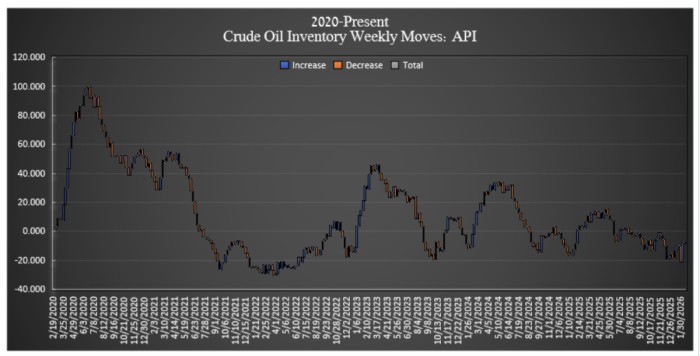
US production stopped its fifth week in a row losing streak, with the average rising by 498,000 bpd during the week of February 6 to 13.713 million bpd, according to the latest EIA data. This is 219,000 bpd more than this same time last year.

At 2:13 pm ET, Brent crude was trading up on the day at $70.38 (+4.39%). Brent is now roughly $1.60 per barrel up from this time last week. WTI was also trading up on the day, by $2.92 (+4.68%) at $65.25.

Gasoline inventories also fell this week, shrinking by 312,000 barrels in the week ending February 13. In the week prior, gasoline inventories rose by 3.3 million barrels. As of last week, gasoline inventories were 4% above the five-year average for this time of year, according to the latest EIA data

Distillate inventories fell in the reporting period by 1.56 million barrels, after losing 2.0 million barrels in the week prior. Distillate inventories were 4% below the five-year average as of the week ending February 6, the latest EIA data shows. 

Cushing inventory—the inventory kept at the delivery hub for the WTI Crude futures contract—fell by 1.36 million barrels, after increasing by 1.4 million barrels in the prior week.

By Julianne Geiger for Oilprice.com

More Top Reads From Oilprice.com


  • Related Posts

    Trump Signals No Ceasefire Extension

    President Donald Trump signaled he is unlikely to extend a two-week ceasefire with Iran that’s set to expire in two days, while Iran has yet to confirm it will participate…

    Kuwait Declares Force Majeure as U.S. Seizure of Iranian Ship Escalates Tensions

    Kuwait has declared force majeure on shipments of crude oil and refined products after disruptions at the Strait of Hormuz prevented some vessels from entering the Persian Gulf. The move…

    Have You Seen?

    UK hydrogen-based synthetic gas start-up raises £25m

    • April 21, 2026
    UK hydrogen-based synthetic gas start-up raises £25m

    Analysis: Why helium’s structural constraints are exposed by geopolitical shocks

    • April 21, 2026
    Analysis: Why helium’s structural constraints are exposed by geopolitical shocks

    Trump Signals No Ceasefire Extension

    • April 21, 2026
    Trump Signals No Ceasefire Extension

    Clean hydrogen investor Hy24 raises stake in Enagás Renovable to 80%

    • April 21, 2026
    Clean hydrogen investor Hy24 raises stake in Enagás Renovable to 80%

    Kuwait Declares Force Majeure as U.S. Seizure of Iranian Ship Escalates Tensions

    • April 21, 2026
    Kuwait Declares Force Majeure as U.S. Seizure of Iranian Ship Escalates Tensions

    Trump Says Energy Chief ‘Wrong,’ Expects Lower Gas Prices as Soon as Iran War Ends

    • April 21, 2026
    Trump Says Energy Chief ‘Wrong,’ Expects Lower Gas Prices as Soon as Iran War Ends

    Trump Cites Defense Production Act to Sign Energy-Related Memorandums

    • April 21, 2026
    Trump Cites Defense Production Act to Sign Energy-Related Memorandums

    North Dakota Oil Production up 4,000 bpd in February vs January to 1,130,000 bpd – State Regulator

    • April 21, 2026
    North Dakota Oil Production up 4,000 bpd in February vs January to 1,130,000 bpd – State Regulator

    Trump Says Energy Chief is ‘Wrong,’ Expects Lower Gas Prices as Soon as Iran War Ends

    • April 21, 2026
    Trump Says Energy Chief is ‘Wrong,’ Expects Lower Gas Prices as Soon as Iran War Ends

    Data Centers Drove Half of U.S. Power Demand Growth in 2025, IEA Says

    • April 20, 2026
    Data Centers Drove Half of U.S. Power Demand Growth in 2025, IEA Says