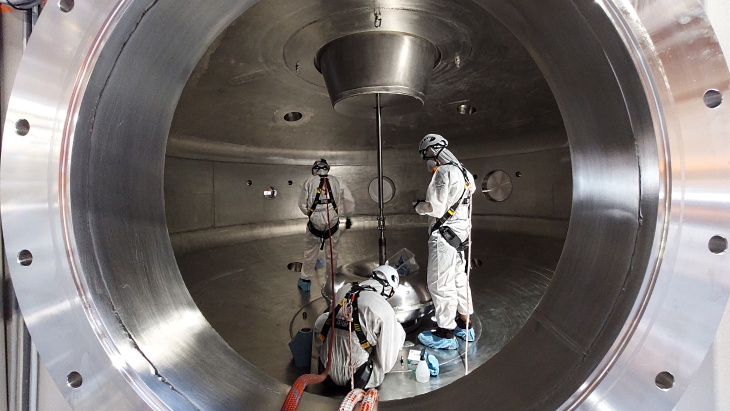
OpenStar is the only company developing a levitated dipole reactor for commercial purposes. In other fusion concepts, the energetic plasma is contained by superconducting magnets pushing the magnetic fields they produce inwards. OpenStar’s approach inverts that process.
More traditional fusion machines – such as tokamaks and stellarators – feature multiple superconducting magnets to produce a complex magnetic field. In contrast, the levitated dipole uses a single magnet to confine a plasma in a much simpler configuration. At the heart of the machine is a powerful magnet that floats freely in a vacuum chamber, held in place by another magnet above it. It levitates in order to confine the plasma around it, meaning no support structures interfere with the super-heated gas. This makes the design potentially simpler, cheaper, and easier to maintain than conventional approaches.
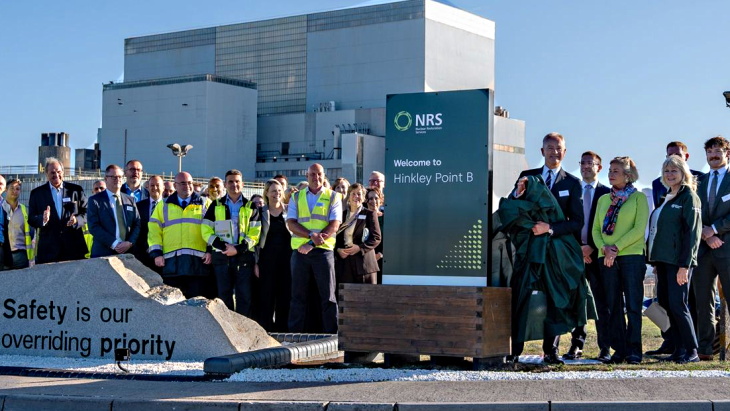
On Tuesday, in the first public demonstration of OpenStar’s technology, attended by Prime Minister Christopher Luxon, Wellington-based OpenStar floated a half-tonne magnet confining a cloud of ultra-hot ionised gas.
By successfully floating the magnet inside the plasma, OpenStar said it has proven the technology powering its first prototype device, Junior, works, and has the ability to work at many times the scale.
Crucial to the successful experiment was the proprietary power supply housed inside the magnet during operation. Because the magnet is floating in a vacuum, it cannot be connected to a power source by wires. The almost lossless all-superconducting circuit acts like a wireless charger, transferring energy into the magnet to keep it powered as it levitates. During the experiment, OpenStar broke the record for energy stored in a magnet by a flux pump power supply at 170 kJ. The company says the design is so efficient that the integrated supply only needs to provide 10 W of electrical power to keep the magnet electrically active for an indefinite float time.
“Tonight, I’m joined by our country’s leaders, to state firmly and clearly that New Zealand is capable of leading the charge into the future of energy,” said OpenStar CEO Ratu Mataira. “Tonight also says very clearly that dipoles are not impossible to engineer, which was the effective assumption of the whole industry. Seeing the magnet levitate while confining plasma is a consequential step from inspired physics to tangible engineering reality. With Junior, we have shown that dipoles have a serious place to play in the global fusion race.”
OpenStar – founded in 2021 – said the progress lays the groundwork for the development of its next prototype device, Tahi, whose magnetic field will be four times stronger than its predecessor, with a magnetic field performing at up to 20 Tesla, or 20 times stronger than the strongest permanent magnet. Establishment of Tahi is being supported by a NZD35 million (USD21 million) commitment from the New Zealand Government’s Regional Infrastructure Fund.
Further experiments using Tahi will yield essential data informing how OpenStar scales to a commercial device, which it aims to have in production by the 2030s.