Investment firms, including KKR & Co. and Energy Impact Partners, are scouting for possible acquisitions.
By Coco Liu and Brian Kahn
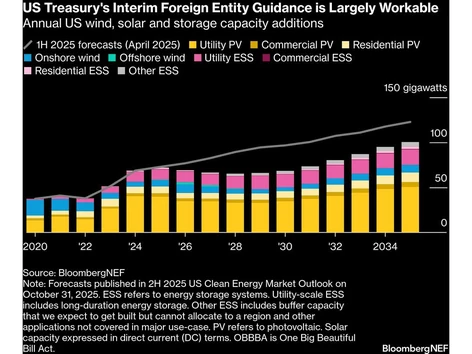
qw(g}0ld37k}ipd0dgh0fd5m_media_dl_1.png BloombergNEF
Get the Latest US Focused Energy News Delivered to You! It’s FREE:
“Renewables, solar in particular, is still the fastest solution to deploy,” said BNEF analyst Musfika Mishi.
The outlook for wind is less bullish given the Trump administration’s open hostility toward the industry and its efforts to cancel projects. The Interior Department in December suspended leases for five offshore wind farms under construction off the East Coast, triggering a legal battle with developers that’s currently being fought in the courts.
“Wind is a very difficult story, no matter what,” Darden said.
Darden and Lagarrigue said their firms prefer solar projects paired with battery storage, which they see as better positioned than wind to withstand political headwinds and market volatility. In states such as Texas and California, where storage is badly needed to help utilities cope with intermittent renewable supplies and prevent outages, investor appetite for giant battery projects is growing, according to Darden.
For batteries, risks persist since much of America’s supplies come from China and can’t be easily sourced elsewhere. That means the threat of tariffs on Chinese goods may change the equation for projects still in early-stage development. And the Chinese government also isn’t shy about using the country’s stronghold as leverage in its trade negotiations with the U.S.
There is “significant tariff risk,” Darden said, requiring additional due diligence. “We’re pretty cautious on how we think about” investing in battery storage, he added.
Even with all the challenges, investors say they remain confident.
“The bar for us is very high,” Energy Impact Partners’ Kobler said. “But we’re still looking, and we’re open for business.”
—With assistance from Mark Chediak.
Share This:
More News Articles