By , , and
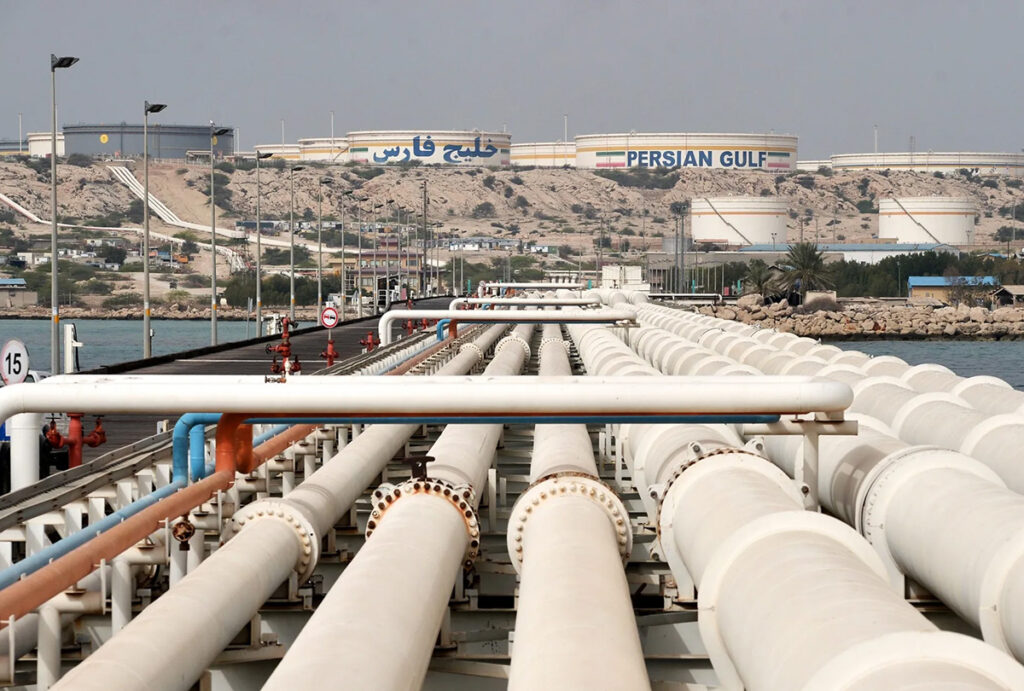
Iran’s main oil export terminal at Kharg Island in the Persian Gulf. Photographer: Fatemeh Bahrami/Getty Images/Anadolu
Get the Latest US Focused Energy News Delivered to You! It’s FREE:
Rising tensions between the US and Iran have already driven oil prices to a six-month high. Oil traders are watching for any escalation that could disrupt crude production in Iran or prompt its government to block a critical shipping route used by several major energy exporters in the region.
The US has deployed a vast array of military forces in the region, and President Donald Trump has said he’s considering a limited strike on Iran as he pressures its government to come to a quick deal limiting its nuclear program. An attack — or a move by Iran to restrict access to the Strait of Hormuz, which carries about a quarter of the world’s seaborne oil — could have consequences for global oil markets.
How significant is Iran’s oil industry?
Iran’s influence has diminished in recent years due to prolonged sanctions and limited foreign investment. Overall, the country accounts for about 3% of global supply, producing roughly 3.3 million barrels per day.
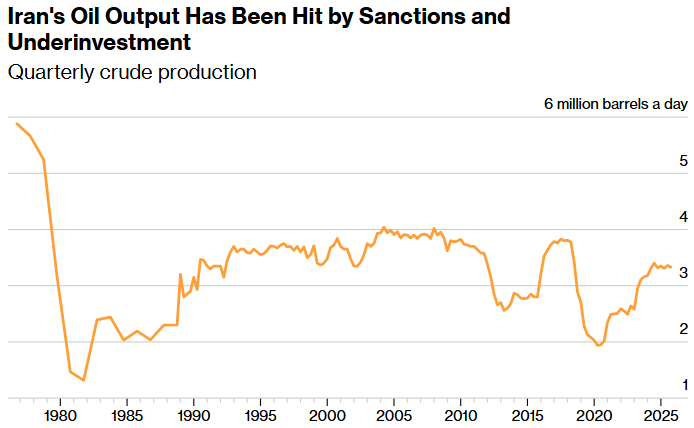
Source: Bloomberg
Iran began developing its oil industry at the start of the 20th century, under the watch of a British government eager to secure reliable supplies. Decades later, the nation became a founding member of the Organization of the Petroleum Exporting Countries and rose to become the group’s second-largest producer. At its peak in the mid 1970s, Iran ranked among the world’s most important oil suppliers, responsible for more than 10% of global crude production.
That dominance unraveled after the 1979 Iranian Revolution, when the new regime expelled foreign companies from the oil industry, curbing investment and outside expertise. The country’s crude output slumped and never reached peak levels again.
The Islamic Republic did ramp up exports after the Iran-Iraq War ended in the late 1980s, to support economic growth. European and US majors eventually sought to reenter the sector. But those efforts collapsed in 2018, when the first Trump administration pulled out of the Iran nuclear deal — an international agreement to limit and monitor the nation’s nuclear program in exchange for sanctions relief — and reimposed sanctions.
Today, Iran is the fourth-ranking oil producer within OPEC, behind Saudi Arabia, Iraq and the United Arab Emirates, according to January production data.
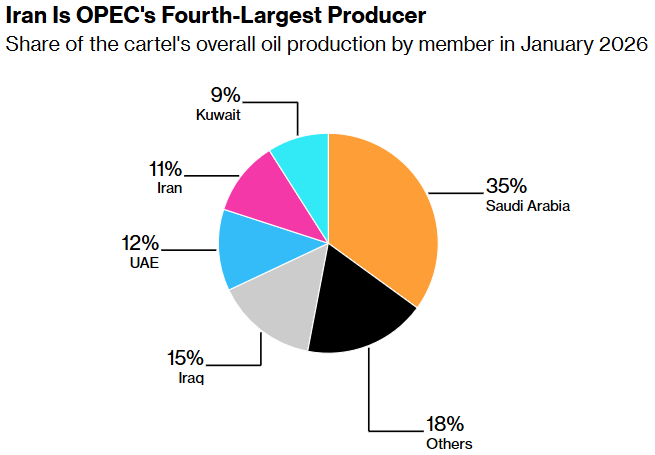
Source: Bloomberg
Who buys Iran’s oil?
In the face of international sanctions, Iran now relies on China to take about 90% of its crude exports, which are sold to independent refiners at a steep discount.
While official customs data suggests China hasn’t imported Iranian crude since mid-2022, barrels are shipped via opaque trading networks and a “dark fleet” of mostly aging tankers. Those flows reached nearly 1.25 million barrels per day in January, compared with 898,000 a year earlier, data from analytics and ship-tracking form Kpler Ltd. show.
Other countries that have continued to buy Iranian cargoes include Syria.
How could a new conflict affect the global oil market?
A large share of Iran’s production — up to 2 million barrels a day — goes to Chinese refineries, which would be forced to seek alternative supplies in the event of major disruption of that output.
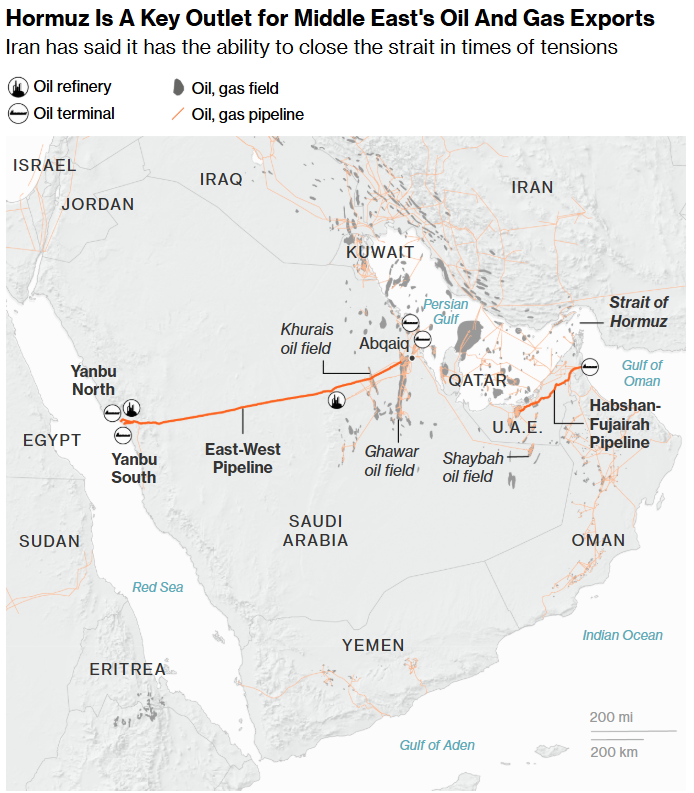
But the bigger risk lies in the threat to the Strait of Hormuz, the backbone of global oil supply, through which Saudi Arabia, Iraq, the UAE and Qatar ship much of their crude.
Why is the Strait of Hormuz so important?
The Strait of Hormuz is the narrow waterway that connects the Persian Gulf with the Arabian Sea. The Iranian government previously said it has the ability to impose a naval blockade during periods of heightened geopolitical tension, though it has yet to effectively block the waterway. If it were to disrupt this key trade chokepoint, shipments of oil, liquefied natural gas and liquefied petroleum gas from Iraq, Kuwait, Saudi Arabia and the UAE would be at risk.
Some 16.5 million barrels of oil a day flow through the strait, including the bulk of Iran’s exports. Saudi Arabia exports the most via the waterway, at roughly 5 million barrels per day, but it can divert shipments by using a 746-mile pipeline that runs across the kingdom from east to west to a port in the Red Sea, where the oil is loaded onto vessels for onward transport. The UAE can likewise bypass this chokepoint by moving its 1.5 million barrels a day through a pipeline that ends at the Gulf of Oman.
A shutdown of the Hormuz Strait would likely disrupt Asia-bound oil flows from the Middle East. In June, when tensions in the region escalated during a 12-day conflict between Israel and Iran, the benchmark rate for a supertanker carrying 2 million barrels of crude from the Middle East to China spiked.
Sources: US Central Intelligence Agency, US Department of Energy
How important is oil for Iran’s economy?
Oil exports remain a central pillar of Iran’s economy, despite years of efforts to reduce dependence on crude and diversify into heavy industry, textiles and mining.
The oil industry contributed roughly 2 percentage points to Iran’s GDP growth in 2023 — a year in which the economy expanded about 5% — underlining how much oil drove overall growth.
While sanctions have forced Iran to sell its oil at steep discounts to international benchmarks in order to attract buyers, the country still earned an estimated $2.7 billion in revenue in November alone, based on Bloomberg calculations using a discounted oil price of $45 a barrel, after shipping and other costs.
Still, Iran’s oil revenue could come under further strain if Trump’s “maximum pressure” campaign on Iran — which includes a series of US sanctions since he took office — deters Chinese buyers. Earnings would face additional pressure if Iran’s government cuts prices to compete with heavily discounted Russian crude.
Share This:
More News Articles