Despite growing technical maturity, post-combustion carbon capture and storage (CCS) projects for power generation continue to face decisive hurdles. Integration complexity, financing structures, and risk allocation now play a central role in determining which projects ultimately reach final investment decision.
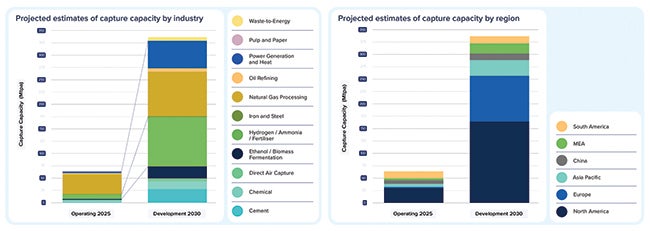
Carbon capture and storage (CCS), while facing renewed policy uncertainty amid an emphasis on rapid fossil-fuel power expansion in the U.S., has made substantial gains worldwide, driven by major policy advances that are propelling projects beyond the pilot stage. According to the Global CCS Institute’s 77 commercial CCS facilities are in operation worldwide, with 734 projects at various stages of development, including 47 under construction. Global operating capacity is projected to rise from 64 million tonnes per annum (Mtpa) today to approximately 337 Mtpa by 2030 (Figure 1). Within that pipeline, 93 projects are classified under “power generation and heat,” spanning coal- and natural gas–fired power plants as well as bioenergy, geothermal, and waste-to-energy facilities, though most remain in early and advanced development stages.
 |
|
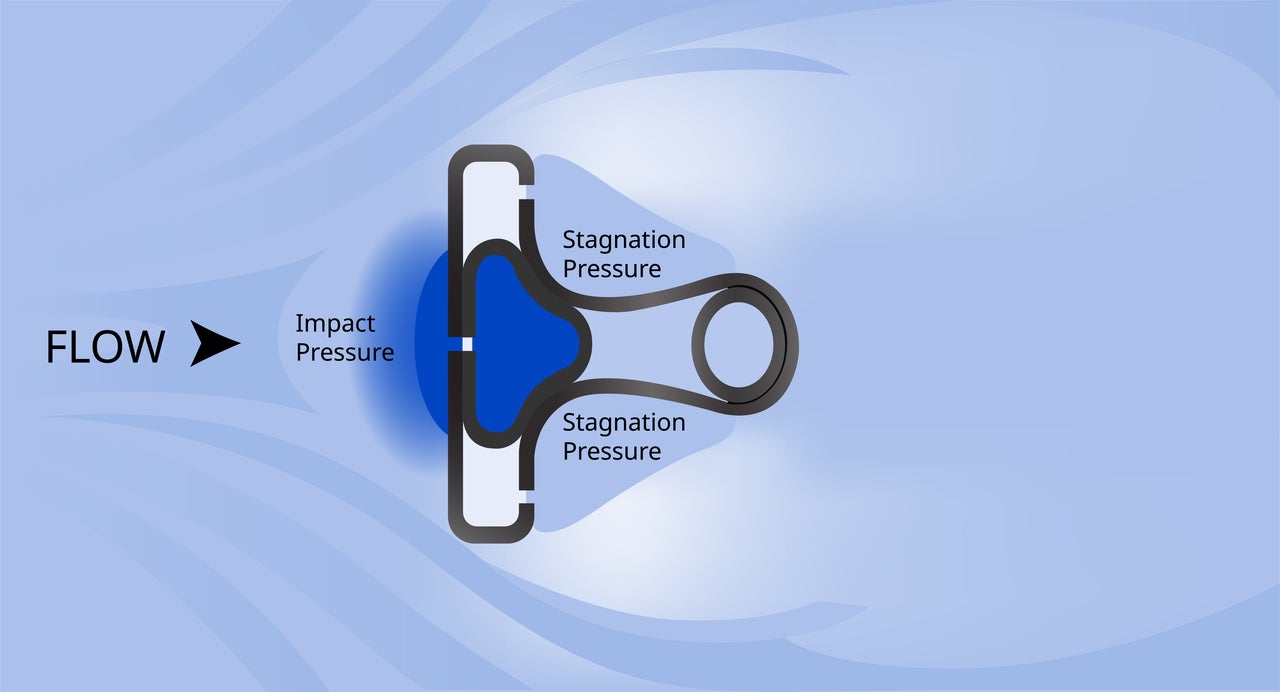
1. The hydrogen and ammonia sector is expected to lead carbon capture and storage (CCS) deployment by 2030, although it is expected to be overtaken by power generation and heat in subsequent years. North America is projected to maintain its capacity lead, while Europe is forecast to surge from under 3 million tonnes per annum (Mtpa) today to more than 90 Mtpa in five years. Courtesy: Global CCS Institute, Global Status of CCS 2025 |
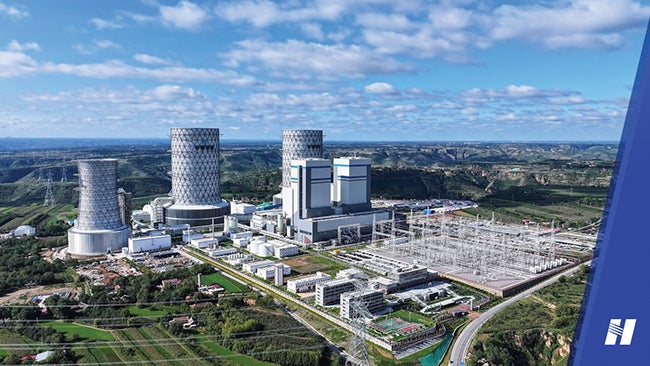
Globally, only about a dozen power generation facilities with CCS are currently in commercial operation, according to the Institute’s facility database. The list includes five coal plants—led by (1.5 Mtpa, commissioned in 2025 and now the world’s largest coal-fired CCS facility, Figure 2) and the U.S.’s (1.4 Mtpa)—and three small natural gas units: in Canada (0.054 Mtpa), Huaneng Yangpu in China (0.002 Mtpa), and Eni Casalborsetti in Italy (0.02 Mtpa). The operational profile, notably, includes two geothermal facilities: Ngawha in New Zealand (0.1 Mtpa) and ON Power Silverstone in Iceland (0.03 Mtpa).
 |
|
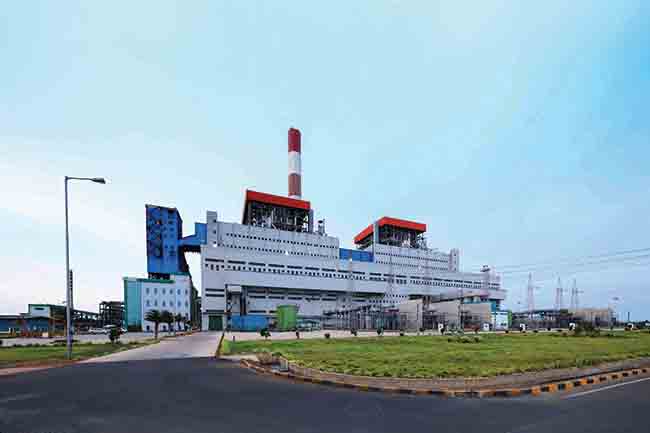
2. China Huaneng Group placed its 1.5 Mtpa post-combustion carbon capture project into operation on Sept. 25, 2025, following a 72-hour trial run at the Zhengning coal-fired power plant (2 × 1,000 MW) in Gansu Province. Integrated into the Huaneng Longdong Energy Base, the facility reportedly captured more than 90% of CO2 from desulfurized flue gas using Huaneng’s proprietary HNC-7 solvent system, with captured CO2 designated for geological storage and utilization, according to the Global CCS Institute. Courtesy: China Huaneng Group |
Still, the Institute notes that natural gas combined cycle plants with CCS are emerging as a focal point in North America, where accelerating electricity demand from artificial intelligence (AI), data centers, and digital infrastructure is renewing interest in firm, dispatchable generation paired with maturing CO 2 transport and storage networks. As of mid-2025, at least 11 natural gas–fired plants linked to data centers had been announced in the U.S. and Canada, including planned generation to serve Meta’s Hyperion AI campus in Louisiana and a multi-gigawatt joint venture by Chevron, GE Vernova, and Engine No. 1.
Not a Technology Problem
For now, experts are generally optimistic that capture technology has matured enough that it is no longer the primary constraint on deployment. “I think maybe the next step will not be in innovation around the chemical or in the case of membranes, kind of like a physical process to separate the CO 2, but really on execution, project execution, and who has the best execution strategy,” said Holly Krutka, business development lead for post-combustion carbon capture at infrastructure firm Williams, during a January panel discussion at POWERGEN International in San Antonio, Texas.
Krutka, who previously directed the Wyoming Integrated Test Center—one of two large-scale post-combustion testing facilities in the U.S.—noted that while innovation in capture chemistry has advanced steadily, “there’s no silver bullet” poised to emerge that will dramatically change the economics. “They’ve all advanced together,” she said, referring to amine solvents, membranes, and dry sorbents. Ben Gurtler, chief operating officer at ION Clean Energy, a post-combustion capture technology developer, confirmed technical readiness, noting that his company has proven capture rates exceeding 99.9% from natural gas flue gas with only a 12% increase in steam demand. Design capture rates of 95% are now achievable with advanced systems on gas combined cycles, he said.
However, performance on a test skid is just one consideration steering a project toward final investment decision (FID). According to the panelists at the conference session, more prominent constraints are rooted in site logistics, contract risk allocation, financing terms, and community acceptance—which are factors that determine whether projects can be built at costs and timelines lenders and equity investors will accept.
Site Integration and Hidden Costs
One emerging prominent consideration is that retrofit applications introduce layers of complexity that feasibility studies often underestimate, experts noted. Jake Kramer, managing director with Ares Management, an infrastructure investor with $600 billion in assets under management, cited site accessibility as a recurring constraint. He pointed out that carbon capture equipment is massive—absorber towers can exceed 300 feet in height—and the ability to fabricate components offsite and deliver them intact directly affects cost outcomes. “The larger the envelope is that you can fabricate off-site and bring to site versus stick build, obviously, the more you’re going to be able to drive costs out of your project,” Kramer said.
Existing brownfield sites may offer built roads and utility access, but if surrounding infrastructure limits the size of deliverable modules, the cost advantage evaporates. Kramer stressed the need to isolate the capture island from the host plant’s operations, particularly for high-reliability applications such as cogeneration facilities serving industrial steam customers. “Ensuring that anything that happens to the carbon capture island does not impact the operations of the power plant is critical,” he said. “You’ve really got to focus on the controls to make sure that they handle those, and it can be quite complex. We spent a lot of time looking at this for projects, and underappreciated how much time and focus needs to be spent on that area.” Site-specific limitations—from height restrictions to water scarcity to plume suppression requirements—can dramatically inflate costs, Gurtler added.
The Financing Conundrum
Even when technical execution appears feasible, securing project financing remains formidable. While banks are broadly supportive of carbon capture, they require projects that have been substantially de-risked: permits in place, (or a clear line of sight to them), bulletproof off-take agreements, clear 45Q monetization strategies, and—perhaps most challenging—engineering, procurement, and construction (EPC) contracts that allocate risk acceptably.
“What banks are looking for is still certainly a lump-sum, turnkey, full wrap” EPC contract, Kramer said. “And as we all know, if you can even get the EPC to provide that today, it’s likely going to come at a significant risk premium that’s likely going to make the project economics challenge and not pencil.”
The alternative—breaking contracts into multiple packages with the owner retaining cost overrun risk—requires equity investors to provide completion guarantees to satisfy lenders, a structure that “can be very challenging for financial investors like ourselves,” he said. Kramer argued that carbon capture’s next wave will depend on “big partnerships coming together to integrate across that full spectrum, full value chain,” a model he compared to “what we’re seeing in the data center space, with the big players again, forming partnerships and vertically integrating.”
Owners also face a painful pre-FID decision: spending “not immaterial amounts of dollars” ahead of final investment decision to lock in long-lead equipment. “Otherwise, if you’re looking to just do everything sequentially, wait for FID and then start locking in some of the long-lead-time equipment … these are just going to really drag out, be a decade-plus,” Kramer said.
The Carbon Credit Reckoning
A difficult conversation is brewing between project developers and the hyperscalers, utilities, and industrial off-takers who have publicly committed to purchasing low-carbon power. Twelve to 18 months ago, Kramer said, many developers believed projects could pencil at an all-in power price—including the premium for carbon attributes—of roughly $100/MWh. “What I think a lot of projects are finding is that’s not going to cut it,” he said, estimating the real figure is closer to $150/MWh.
The gap stems largely from the value ascribed to carbon credits, which Kramer argued need to approach levels seen for carbon removal projects like direct air capture—potentially hundreds of dollars per tonne—rather than generic $20-per-tonne offsets. The 45Q tax credit, while helpful and enjoying bipartisan congressional support, does not cover the full cost of capture, transport, and storage for post-combustion applications on natural gas combined cycles, Krutka noted. “It’s not—at least until we have further decreases in cost from learning by doing or some other mechanism, so we still have to bridge that gap,” she said.
Community Engagement and Supply Chain Constraints
Beyond technical and financial hurdles, projects face a risk that is harder to model: community opposition to CO 2 transport infrastructure and injection wells. Krutka called successful community engagement her “fourth criterion” for reaching FID, alongside logistics, economics, and favorable geology. “That can derail a great project,” she said.
Physical supply constraints represent yet another execution bottleneck. While power generation equipment supply chains face their own pressures, the CCS-specific supply base is even less mature. “Some of the supply chain for some of the projects that we’re evaluating with our customers, it’s not ramped up to meet that,” Krutka pointed out. “You have to procure long-lead items, which can even include, like, growing the supply chain before you’ve reached FID.”
Finally, the urgency of matching AI-driven power demand growth with low-carbon generation is compressing traditional development timelines, and that may be prompting developers to make commitments “with less certainty than probably historically was acceptable,” she said.
Asked what single development could most accelerate post-combustion carbon capture deployment over the next five to 10 years, Krutka offered two answers: “One, for sure, is just having more projects built so that the supply chains are getting stood up,” she said. “And then the other really is just kind of demystifying CCS to the public to the point where they’re as interested in it as all of their energy technologies, which is not very much—because it’s just well understood.”
—Sonal Patel is a POWER senior editor (, ).