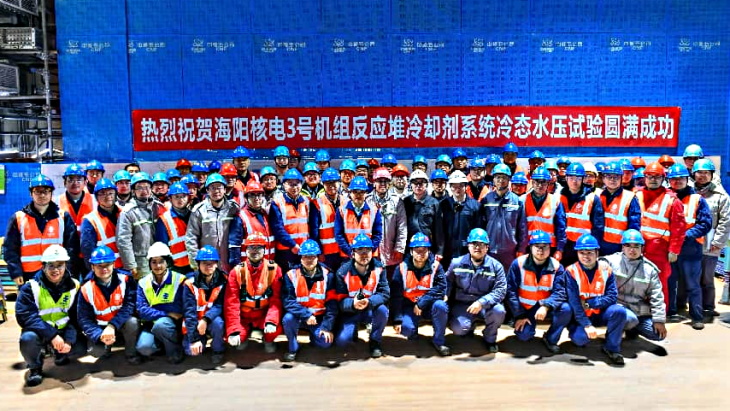
Such tests are carried out to confirm whether components and systems important to safety are properly installed and ready to operate in a cold condition. The main purpose of cold functional tests is to verify the leak-tightness of the primary circuit and components – such as pressure vessels, pipelines and valves of both the nuclear and conventional islands – and to clean the main circulation pipes. The tests mark the first time the reactor systems are operated together with the auxiliary systems.
“The cold test confirmed that the four main coolant pumps and their domestically produced frequency converters of Unit 3 are operating normally, the primary loop pressure boundary integrity is good, the pressure-bearing performance meets standards, and the installation quality of related system equipment is excellent,” State Power Investment Corporation (SPIC) said. “The test was a success on the first attempt.”
Completion of the cold tests lays “a solid foundation for subsequent key milestones such as hot functional testing and reactor fuel loading, as well as high-quality commissioning,” it added.
Hot functional tests involve increasing the temperature of the reactor coolant system and carrying out comprehensive tests to ensure that coolant circuits and safety systems are operating as they should. Carried out before the loading of nuclear fuel, such testing simulates the thermal working conditions of the power plant and verifies that nuclear island and conventional equipment and systems meet design requirements.
The construction of two new reactors at each of the Sanmen, Haiyang and Lufeng sites was approved by China’s State Council in April 2021. The approvals were for Sanmen units 3 and 4, Haiyang 3 and 4 and units 5 and 6 of the Lufeng plant. The Sanmen and Haiyang plants are already home to two Westinghouse AP1000 units each, and two CAP1000 units – the Chinese version of the AP1000 – were approved for Phase II (units 3 and 4) of each plant.
The first safety-related concrete was poured for the nuclear island of Haiyang unit 3 in July 2022, and in March the outer steel dome of the nuclear island containment building was hoisted into place. Construction of Haiyang 4 began in April last year. The planned construction period for Haiyang 3 and 4 was 56 months, with the two units scheduled to be fully operational in 2027.
Cold functional tests were completed at unit 3 of the Sanmen plant last month.