By and
- California now more dependent on costlier fuel imports from Asia
- West Coast refineries account for about 50% of Middle East crude imports to US
- Prices spike for alternative barrels of crude due to Asia demand
HOUSTON, March 13 (Reuters) – Fuel costs in California are soaring even more than in the rest of the U.S. due to several unique factors, with fallout from the war in Iran forecast to push pump prices in the state to $10 a gallon and jet fuel prices jumping 47% in just two weeks.
Get the Latest US Focused Energy News Delivered to You! It’s FREE:
California’s mandated gasoline blend and lack of pipeline access isolate it from the rest of the U.S. market, making it heavily reliant on energy imports from Asia that are being held up by closure of the Strait of Hormuz.
Consumers in the state already face the highest gasoline prices in America, with more pain on the way.
“The U.S. West Coast will become the poster child for the consequences of the attacks on Iran,” energy economist Philip Verleger wrote in a note, adding that California drivers can expect gasoline and diesel shortages soon and prices possibly above unprecedented levels of $10 per gallon.
Over the past month, average regular gasoline prices in California jumped more than 18%. The pump price hit $5.42 per gallon on Friday, much higher than the national average of $3.63 per gallon, according to AAA, the American Automobile Association. Jet fuel prices in Los Angeles, a major aviation hub, have soared more than 47% to about $3.85 a gallon since the conflict in the Middle East started, according to OPIS data.
West Coast states will need to reduce their gasoline and diesel use by 20%, Verleger added, if nations that export fuel to the region restrict or ban flows to protect domestic markets.
VULNERABLE TO SUPPLY SHOCKS
California, once a top oil producing state in the U.S., has in recent years become more dependent on crude and fuel imports as some refineries shut or converted to produce renewable fuels amid a shift away from fossil fuels. That reliance has left the state more vulnerable to supply shocks, some analysts warned.
A shortage of Middle Eastern crude has forced refineries in China, Korea and India to cut back production, with some declaring force majeure — a legal move that allows companies to halt deliveries during emergencies. Some countries, including China and Thailand, have suspended fuel exports.
The U.S. West Coast imported a record amount of 128,000 barrels per day of motor gasoline and additives last year, with most coming from South Korea and India. California also imported about 54,000 bpd of jet fuel, nearly a third of which came from South Korea, according to ship tracking firm Kpler.
Korean imports will dry up for a while, and neighboring Washington state does not have much more spare refining capacity, said Randy Hurburun, head of refining at Energy Aspects.
West Coast refineries also imported about 230,000 barrels per day of Middle Eastern oil, according to Kpler, accounting for about 50% of Middle East crude imports to the United States.
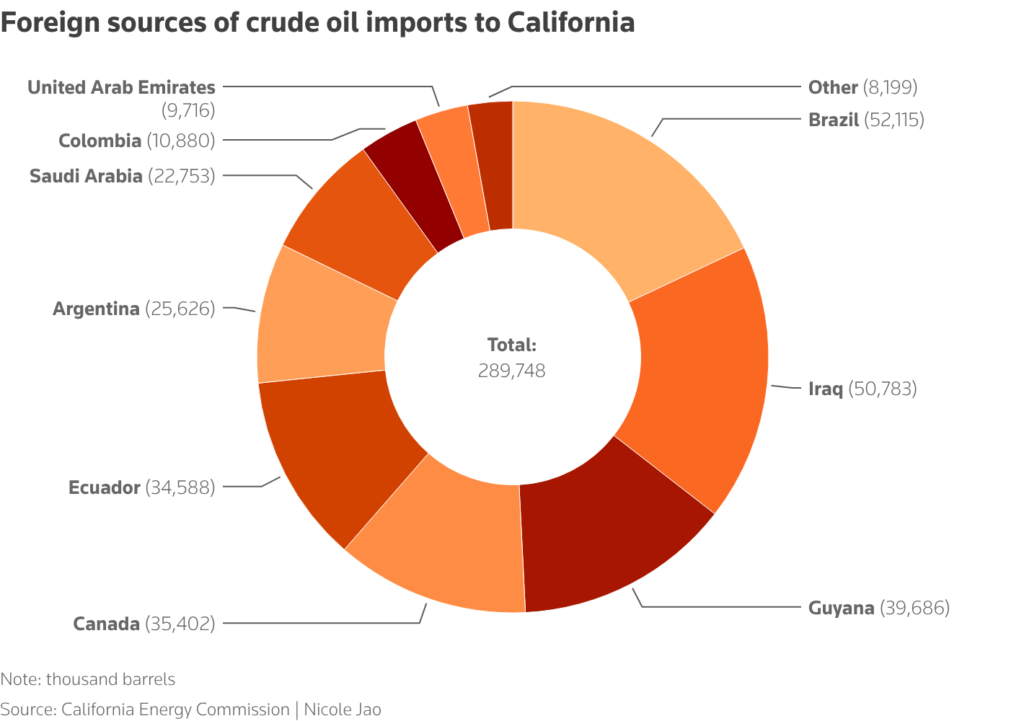
Foreign sources of crude oil imports to California
The refineries must now seek alternative barrels, which will cost more now. Heavy crude prices have spiked as refiners globally scramble to secure enough oil.
“All the crude that West Coast refiners import from the Middle East is at risk,” said Matt Smith, an analyst at Kpler, adding that the refineries will be forced to buy crude oil from Canada or Latin America.
Chevron-owned (CVX.N) refineries in Richmond and El Segundo and Marathon Petroleum’s (MPC.N) Los Angeles facility were California’s largest importers of crude in 2025, EIA data showed.
A spokesperson said Marathon was meeting all contractual obligations, but declined to comment on crude sourcing or refining. A Chevron spokesperson declined to comment on daily operations but noted the refineries continue to supply customers in the region.
FEW ALTERNATIVES
Availability of alternative crude oil is also limited due to strong demand from Asia.
At best, just about half a million barrels of Canadian oil is available to West Coast refiners due to constraints on Canada’s Trans Mountain Pipeline, and to demand from Chinese buyers, Kpler’s Smith noted. Asian refiners may also try to buy more Latin American crude from Ecuador or Guyana.
“There is not a great deal of incremental supply available to U.S. West Coast refiners,” Smith said.
West Coast refiners will try to maximize Alaska North Slope crude supply, redistribute Canadian supplies, and may buy Venezuelan oil despite the shipping challenges, Rystad’s Bell said.
President Donald Trump is considering temporarily waiving a shipping rule called the Jones Act, which requires domestic crude to be shipped on U.S.-flagged tankers, making it more expensive for California refiners to ship from the U.S. Gulf Coast. This step could provide some price relief.
“All other regions are also needing barrels at this point due to a widespread panic of availability,” said Debnil Chowdhury, head of refining and marketing at S&P Global Energy. “There’s competition now for the barrels.”
Reporting by Arathy Somasekhar in Houston and Nicole Jao in New York; Editing by David Gregorio
Share This:
More News Articles