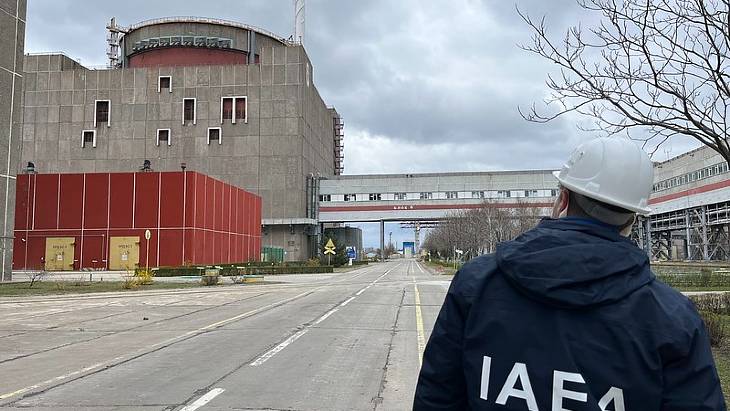
In its latest update on the situation, the International Atomic Energy Agency (IAEA) said that the six-unit Zaporizhzhia plant, which has been under Russian military control since early March 2022, had to rely on its recently repaired 330 kV backup line for several hours to allow maintenance work on its main power line.
IAEA Director General Rafael Mariano Grossi said: “The ZNPP’s fragility in the face of limited off-site power options is putting constraints on electrical maintenance. It is another indication of the critical importance of robust, diverse and dependable off-site power infrastructure to ensure nuclear safety and security.”
Since the war began, the Zaporizhzhia plant has lost access to off-site power 12 times, during which emergency backup diesel generators (EDGs) have had to provide the power required for essential safety functions.
The IAEA also reported that the State Nuclear Regulatory Inspectorate of Ukraine had informed it that “during the night of 11-12 March, attacks targeting and destroying an electrical substation close to the subcritical Neutron Source Installation at the Kharkiv Institute of Physics and Technology resulted in its disconnection from the electrical grid until 13 March. During this outage, the facility relied on EDGs”.
IAEA officials at Chernobyl said that the following day, the site was disconnected from its main 750 kV transmission line for nearly 24 hours, with the Ukrainian nuclear regulator saying the cause was an attack on an electrical substation. The “disconnection and subsequent fluctuations in the electrical grid automatically activated the EDGs supplying the New Safe Confinement and Interim Spent Fuel Storage Facility 1. The generators were manually switched off after 15 minutes”.
Grossi said: “These episodes underscore how grid instability and the vulnerability of off-site power is affecting nuclear safety and security at Ukraine’s nuclear facilities.”