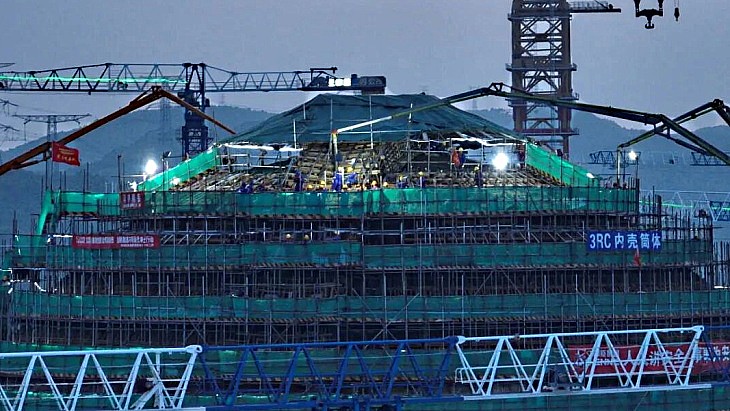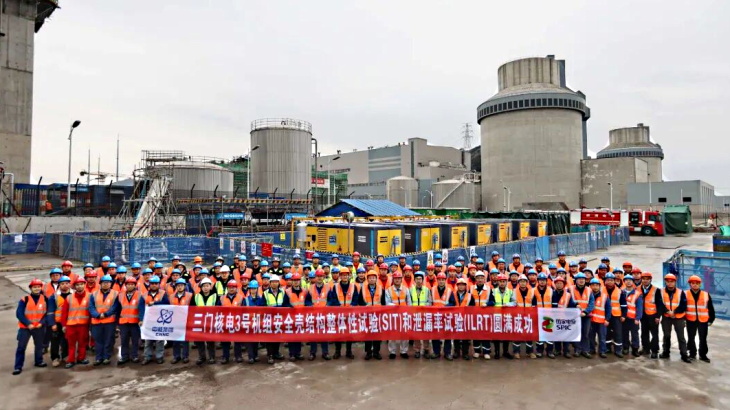
The two-part tests confirm that the containment vessel meets design and construction quality requirements. The first part – the structural integrity test (SIT) – involved the vessel being pressurised and monitored to confirm that its design and construction meet all applicable industry codes and standards at 110% of design pressure.
The vessel was then pressurised to design pressure and the integrated leak rate test (ILRT) was performed to demonstrate its ability to prevent the release of radioactive materials in the event of an emergency.
During the containment pressure test, the containment leakage is checked through the acoustic leak detection test, and the changes in the containment structure performance are monitored through internal visual inspection and external visual inspection tests.
“Conducting SIT and ILRT tests before commissioning a new unit is a core step in verifying the reliability of the barrier,” China National Nuclear Corporation (CNNC). “These tests simulate the pressure conditions under a design baseline accident by injecting compressed air into the steel containment vessel, comprehensively verifying the structural integrity and overall sealing performance of the containment’s pressure-bearing boundaries.”
It added: “The successful completion of this test fully verified the manufacturing and installation quality of the containment vessel, laying a solid foundation for subsequent similar tests and hot-testing of the unit.”
The construction of two new reactors at each of the Sanmen, Haiyang and Lufeng sites in China was approved by China’s State Council in April 2021. The approvals were for Sanmen units 3 and 4, Haiyang 3 and 4 and units 5 and 6 of the Lufeng plant. The Sanmen and Haiyang plants are already home to two Westinghouse AP1000 units each, and two CAP1000 units – the Chinese version of the AP1000 – were approved for Phase II (units 3 and 4) of each plant.
The first safety-related concrete was poured for the nuclear island of Sanmen 3 on 28 June 2022, marking the official start of its construction. The first concrete for that of unit 4 was poured on 22 March last year. The units are expected to be connected to the grid in 2027 and 2028, respectively.
Cold functional tests – carried out to confirm whether components and systems important to safety are properly installed and ready to operate in a cold condition – were completed in February.
Hot functional tests – which involve increasing the temperature of the reactor coolant system and carrying out comprehensive tests to ensure that coolant circuits and safety systems are operating as they should = will be carried out before the loading of nuclear fuel. Such testing simulates the thermal working conditions of the power plant and verifies that nuclear island and conventional equipment and systems meet design requirements.
Two Hualong One (HPR1000) reactors are planned for Phase III (units 5 and 6) of the Sanmen plant.