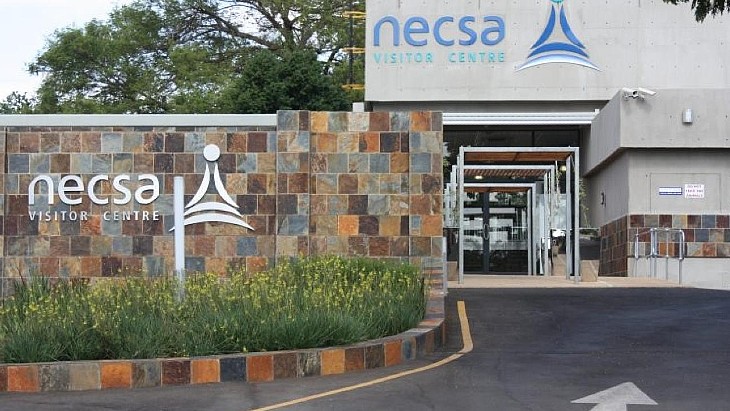
CEO of the state-owned South African Nuclear Energy Corporation (Necsa), Loyiso Tyabashe, said: “Through the Expression of Interest (EOI) process, Necsa seeks to gather detailed information on available SMR technologies, their maturity, licensing experience, and deployment readiness. Our aim is to demonstrate an SMR technology that will produce power, process heat and isotopes. This gives Necsa an opportunity to assess existing capabilities and financing models to fulfil its strategic objectives of positioning South Africa at the forefront of advanced nuclear technologies.
“We aim to participate in the global SMR supply chain and contribute meaningfully to the local nuclear industrialisation plan through building local capabilities for nuclear build programmes.”
Necsa chairman David Nicholls said: “The EOI serves as the first stage of a structured selection process. It prequalifies respondents based on alignment with South Africa’s nuclear policy and experience base, technology readiness for timely deployment, financial strength for long-term delivery, commitment to intellectual property transfer and localisation of skills and technology, and the diversity of applications to maximise socio-economic and industrial benefits.”
The EOI document says it will serve “as a prequalification and market-sounding process prior to issuing a formal competitive bid”, such as a request for proposals (RFP). It will help “assess market interest in partnering on the development of an SMR in South Africa” and “identify suitably qualified and experienced organisations; and shortlist respondents with proven technical and financial standing”.
The document says that the EOI will function as the first stage of a structured selection process, and “only respondents that meet the prequalification requirements will be invited to participate in the subsequent RFP stage”.
The prequalification criteria are listed as: Alignment of reactor design with South African nuclear policy and established experience base; appropriate technology readiness to support successful and timely deployment; demonstrated financial strength to sustain long-term project delivery; commitment to intellectual property transfer and localisation of skills and technology; and application diversity to maximise socio-economic and industrial benefits.
It adds: “The overarching objective of this structured EOI–RFP approach is to identify and partner with an organisation that demonstrates technical credibility, financial robustness, policy alignment, and a collaborative approach to delivering a world-class SMR demonstration plant in South Africa.”
The SMR programme is in line with the South African Integrated Resource Plan published in October which laid out plans for 5,200 MW of new nuclear capacity by 2039, while also suggesting that figure could reach 10,000 MW.
The IRG included the development of a Nuclear Industrialisation Plan “to plot a roadmap determining the minimum capacity to reach the economies of scale for the entire nuclear fuel cycle value chain within the country. Demonstration of multiple purpose nuclear reactors by 2032, as the country positions itself to adopt nuclear energy for net zero by 2050. This is important to demonstrate viability to implement a successful full value chain nuclear programme. A case for 10 GW of nuclear rests on the economic viability of re-establishing the nuclear fuel cycle, using nuclear for both power and industrial applications (non-power).”
South Africa’s future nuclear growth plans have also included November’s decision to take the Pebble Bed Modular Reactor (PBMR) out of care-and-maintenance, to further develop the technology and to transfer the Pebble Bed Modular Reactor company from Eskom to Necsa. The PBMR was to have been a small-scale high-temperature reactor using graphite-coated spherical uranium oxycarbide tristructural isotropic (TRISO) fuel, with helium as the coolant, able to supply process heat as well as generating electricity. Based on well-proven German technology, South Africa had been working on the PBMR project since 1993, and PBMR Ltd was established in 1999 with the intention of developing and marketing the reactor. However, in 2010 the then government formally announced its decision no longer to invest in the project, which was then placed under care and maintenance.