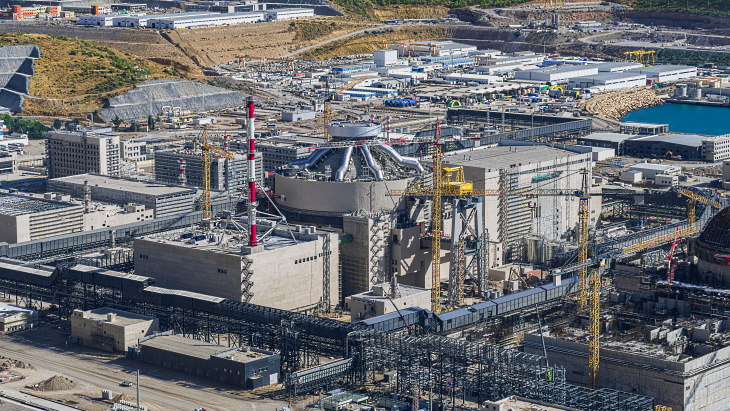
The dome – measuring 52 metres in diameter, 12 metres in height and weighing about 415 tonnes – was hoisted into place on top of the containment building using a 4,000-tonne crawler crane on 13 April. The process of raising the outer dome into position took two hours.
China National Nuclear Corporation (CNNC) said the installation of the outer dome of unit 4 “marks the entry of the second phase of the Changjiang Nuclear Power Plant civil construction project into the final stage”.
_eff2fee6.jpg)
(Image: CNNC)
The Hualong One reactor design features a double-layered containment building, the main function of which is to ensure the integrity and leak tightness of the reactor building, and it plays a key role in the containment of radioactive substances.
Construction of the unit is being undertaken by CNNC subsidiary CNNC 22nd Engineering Co Ltd. “This installation was the result of a series of systematic innovations and collaborative efforts in the fields of technology and management,” CNNC said. “The CNNC 22nd Engineering Co Ltd project team adopted several groundbreaking measures to build a comprehensive support system for the installation task.”
_bd20c114.jpg)
(Image: CNNC)
The entire hoisting process utilised 3D modeling technology, CNNC noted. A full-size digital model of the outer dome was constructed in advance, allowing for precise simulation and collision detection of the hoisting path and key connection points, thus mitigating potential risks from the outset. Based on the 3D model, multi-level technical briefings and construction simulations were conducted, providing solid technical support for the successful one-time hoisting of the outer dome.
Two Hualong One reactors are being constructed in the second phase of the Changjiang plant. First concrete was poured for the base slab of unit 3’s nuclear island in March 2021, with that of unit 4 being poured in the December of that year. Changjiang Phase II – units 3 and 4 – represents a total estimated investment of CNY40 billion (USD5.9 billion), according to China Huaneng, which holds a 51% share in the project. The construction period is expected to be 60 months. Both units are scheduled to be fully operational in early 2027.
_e0134194.jpg)
(Image: CNNC)
“After completion, the annual power generation [by Changjiang units 3 and 4] will reach 18 billion kilowatt-hours, which is equivalent to saving 6.326 million tonnes of coal and reducing carbon dioxide emissions by 11.68 million tonnes per year,” China Huaneng said.
The Changjiang nuclear site is already home to two operating CNP-600 pressurised water reactors (PWRs) – Changjiang 1 and 2 – which entered commercial operation in 2015 and 2016, respectively. In 2021, CNNC also began construction of a demonstration ACP100 small modular reactor at the site. The multi-purpose 125 MWe PWR – also referred to as the Linglong One – is designed for electricity production, heating, steam production or seawater desalination. It is currently undergoing pre-commissioning tests.
The island province of Hainan is China’s southernmost point. Energy policies published in 2019 by Hainan Province Development and Reform Commission specify that nuclear power will become the primary source of electricity for the island, which has a population of close to 10 million.