Wednesday, 29 January 2025
The project – announced in June 2022 – is being funded by the European Commission’s Euratom Research and Training Programme, and is in addition to the study Tractebel is already carrying out for the European Space Agency on the possibility of producing Pu-238 in the European Union.
The consortium includes the Joint Research Centre of the European Commission, the Belgian Nuclear Research Centre (SCK-CEN), the French Alternative Energies and Atomic Energy Commission (CEA), INCOTEC, ArianeGroup, Airbus Defense and Space, the University of Bourgogne Franche Comté and Arttic.
Tractebel says that with current nuclear batteries, radioisotope thermoelectric generators (RTGs), “substantial amounts of fuel and large RTG are needed to power missions, which increases the weight to be launched by the space rocket … the project aims to significantly increase the efficiency of the radioisotope power system thanks to an advanced Stirling engine”.
PULSAR also aims to develop technology and capabilities in Europe to produce Pu-238 – currently no Pu-238 or radioisotope power system are manufactured in Europe and “as space has become a strategic and economic priority for Europe” its dependence on other countries “is a major concern”.
Completed at the end of 2024, the project delivered significant outcomes, including: a conceptual radioisotope power system design tailored for lunar applications; a feasibility study for Pu-238 production in Europe; and a market analysis exploring the potential of dynamic power systems beyond space applications.
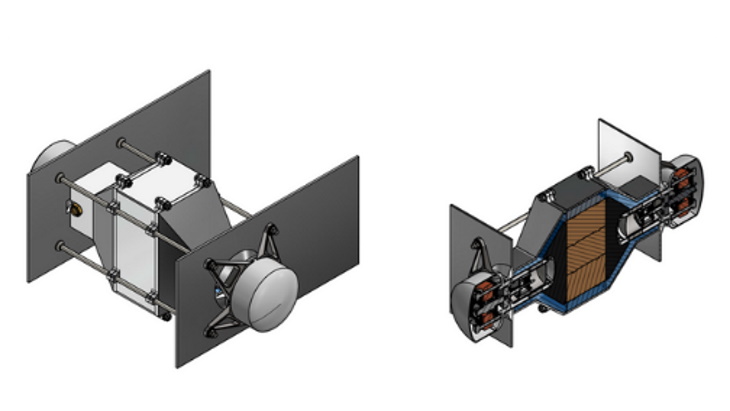
The PULSAR consortium’s radioisotope power system (RPS) is designed to support a lunar rover or cargo carrier requiring 100–500 We. It incorporates safety measures for launch from the Guiana Space Centre and features two Stirling engines powered by a centrally located Pu-238 heat source. The modular design ensures resilience against motor failure, with an expected thermo-electrical conversion efficiency of 20%.
Tractebel said its nuclear experts conducted comprehensive engineering studies, including structural integrity checks, radiation dose assessments, thermal analysis, and mechanical assembly development. The team developed a 3D mechanical and thermal model to simulate lunar conditions, providing a foundation for future design iterations and higher Technical Readiness Levels. It said this work lays the groundwork for Europe’s participation in the upcoming Argonaut lunar lander mission.
“What the PULSAR consortium has achieved will help position Europe as an autonomous global leader in space nuclear technologies,” said Tractebel’s Brieuc Spindler, PULSAR project manager. “Tractebel leads European research projects focused on advancing nuclear technologies for space exploration, including RPS and radioisotope production, electric propulsion, and fission surface systems. By leveraging our nuclear expertise, we are pushing the boundaries of space exploration and enabling Europe to lead in this final frontier.”
The space community has relied mainly on photovoltaic power systems, a technology that was originally developed for the purpose of space applications and has found many terrestrial uses. However, these systems pose severe limitations for missions to places like the outer solar system. The available solar energy reduces with the square of the distance from the sun. For example, at Saturn the solar power density is a hundred times lower than at Earth. There is also the issue of the two week-long nights on the Moon.
It has meant that radioisotope power sources – sometimes referred to as nuclear batteries – fuelled with Pu-238 have generally been used in space missions since the early 1960s. Radioisotope thermoelectric generators and radioisotope heater units can provide power and heat continuously over long, deep space missions. Pu-238 is made by irradiating neptunium-237, recovered from research reactor fuel or special targets, in research reactors.