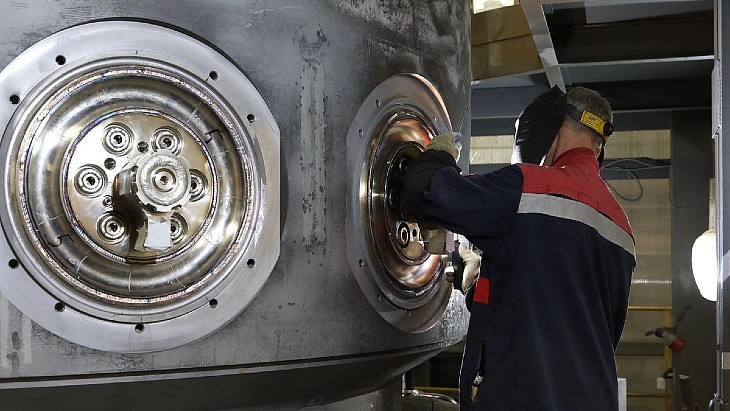
Each of the Project 22220 nuclear icebreakers has two RITM-200s – pressurised water reactors with a thermal capacity of 175 MW, which converts to 30 MW at the propellers. It is 7.3 metres high with a diameter of 3.3 metres and an integral layout which its manufacturers say means it is lighter, more compact and 25 MW more powerful than previous generations used on nuclear-powered icebreakers. The service life is 40 years.
In addition to this one, which is the first for the Leningrad icebreaker under construction, a further 15 RITM reactor units are in various stages of production – for nuclear icebreakers, land-based SMR plants and floating power units.
The process of manufacturing the RITM-200 reactor unit concludes with test assembly, with all components assembled in their design positions “down to a thousandth of a millimetre” Rosatom said: “Successful completion of this operation allowed engineers to ensure the product was fully prepared for shipment and subsequent installation into the ship’s hull, ensuring reliable operation for at least the next 40 years”.
The second reactor unit for the Leningrad – whose keel was laid in January 2024 – is currently being prepared for hydraulic testing ahead of test assembly.
Anton Lebedev, head of ZiO-Podolsk, said: “Our company has already manufactured 10 RITM-200 reactor units and two more powerful RITM-400 units. Over the years, we have accumulated a colossal amount of knowledge and skills, and today we possess competencies unmatched anywhere else in the world.”
Background
There are currently a series of Project 22220 nuclear-powered icebreakers operating – the Arktika, Sibir, Ural, the Yakutia, plus the Chukotka, which has beenundergoing mooring tests- and two under construction, the Leningrad and the Stalingrad at the Baltic Shipyard.
Within Rosatom’s machine-building division, Afrikantov OKBM is the designer, complete supplier, and manufacturer of the reactor internals for the RITM-200 and RITM-400 reactor units. Reactor vessel fabrication and test assembly are performed at ZiO-Podolsk.
The Project 22220 vessels are 173 metres long, 34 metres wide and with a height from the waterline to the mainmast of 57 metres. They are designed to break through ice up to three metres thick and have a speed of 22 knots in clear water. The first four have been escorting cargo ships along the Northern Sea Route for several years now.
There is also a larger nuclear-powered icebreaker under construction, the Rossiya, which will be the first of the proposed Project 10510 nuclear-powered icebreakers. It will feature two RITM-400 reactors for a propeller power of 120 MW. It will be able to penetrate ice up to 4.3 metres thick and clear a channel up to 50 metres wide. It has a reported construction target service date of 2030.
Nuclear-powered icebreakers are a key part of Russia’s plan to develop the Northern Sea Route, the shipping lane along its north coast which allows faster transport between Europe and Asia.