The Czech plant says that the pair have now had 18 chicks at the plant, where an artificial nesting box has been installed at the sort of high levels – more than 120 metres – that the birds seek out.

(Image: CEZ)
Roman Havlín, Director of Dukovany Nuclear Power Plant, said: “The project demonstrates that the operation of strategic energy infrastructure can be successfully combined with the active protection of endangered species and a long-term sustainable approach to the surrounding landscape.”
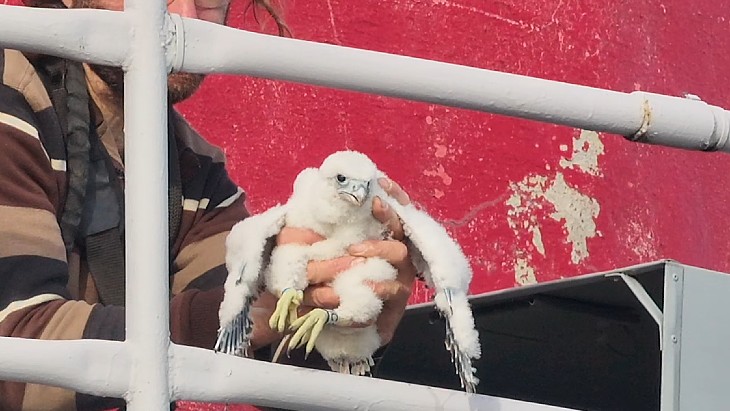
Aluminium rings are placed on the birds, which will identify them (Image: CEZ)
The scheme is run by operator CEZ at a number of its power plants in collaboration with ALKA Wildlife, whose ornithologist Václav Beran said, after checking out the young birds: “The inspection confirmed that all the chicks are in very good condition and that the parents are taking appropriate care of them.”
CEZ said that the young hatch at the end of April or early May and remain in the nest for about two months.
Ornithologists regularly monitor falcon pairs in CEZ locations – which also include Temelín Nuclear Power Plant. Since 2011, at least 206 peregrine falcon chicks have been raised at the sites.
According to the UK’s Royal Society for the Protection of Birds, peregrine falcons require extensive open terrain for hunting, with traditional nesting sites being cliff-ledges, quarry faces and crags, but adds that they have “recently started to use man-made constructions, especially tall buildings”.
The guide goes on to explain: “With their streamlined body, razor-sharp talons and incredible eyesight, peregrines are the ultimate high-speed hunters. They can reach speeds of around 200 miles per hour as they plummet out of the sky in pursuit of prey, making them the fastest animals on the planet. They tend to eat medium-sized birds, such as wading birds and pigeons, but have also been known to take smaller birds, and even bats. To help protect their delicate eyes from wind and dust as they hurtle through the air, peregrines have special built-in ‘goggles’ in the form of a third eyelid that they can draw across their eyes.”
Their numbers dropped in the middle of the 20th Century in many countries, thought to be linked to the use of DDT as a pesticide on crops, but their numbers have been increasing since the end of DDT use, and with increased conservation measures.