Gasoline accounts for a shrinking share of household budgets, but its political power can still make or break a presidency.
By

In his 1987 book, Trump: The Art of the Deal, then-real estate mogul Donald Trump wrote that one of his 11 “Elements of the Deal” is to “know your market.” Rather than relying on number crunchers or third-party surveys, Trump said he prefers to use his gut: “I like to think I have that instinct.”
Get the Latest US Focused Energy News Delivered to You! It’s FREE:
Ever since that gut instinct led to him to partner with Israel to attack Iran in February, Trump’s eye has arguably been on the oil market, and, more specifically, the US retail price of gasoline. For decades — coincidentally, at least since the Iranian Revolution and hostage crisis of 1979-80 — the price at the pump has been a crucial lens through which Americans judge a president’s success or failure.
In this conflict, the impact on gasoline prices matters more to individual Americans than the broader military campaign, the removal of Iran’s enriched uranium, or sending in ground troops.
It’s not going well. Since the war began 10 weeks ago, the average price of gasoline in the US rose by 52% by May 13, to $4.53 per gallon — the highest level in four years. Trump maintains the increase will be short-term and a small price to pay for preventing the world’s largest sponsor of terror from obtaining a nuclear weapon.
In a sense, Trump is right. The price of gas is small and getting smaller, at least relative to income. The problem is that the cost of fuel is intimately tied up with American identity.
Freedom to Roam
When I arrived in the US from South Africa in 2017, it was obvious that I was now in car country, even as the energy transition loomed on the horizon. The roar of vehicles hurtling down 16-lane Interstate 10 in Houston — from two-ton Ford F-150 trucks to raspy Chevrolet Corvettes, many traveling far faster than the 65 mph speed limit — was impossible to ignore. It was clear that gasoline had a long future, at least in this part of Texas.
Even so, US voters’ preoccupation with gasoline prices as an indicator of economic health remained a curiosity. This is especially true in 2026, when electrification and the digital world are poised to dominate the future.
Sure, Americans drive a lot. Public transport outside major cities is minimal and rising costs disproportionately affect lower-income groups. When freight costs rise, inflation ripples through the economy. EV adoption, while steady, is slowing.
But since I settled in the US, where I’m now a citizen, gasoline prices have averaged $3.07 a gallon. That’s about 15% less than the retail price of a gallon of milk over the same period (though of course Americans buy a lot more gas than milk in an average week.)
Still, the proportion of household budgets spent on filling up has fallen steadily in recent years and is now just under 2%, even accounting for the price spikes in 2022 and 2026. A gallon of gasoline is more than $1 cheaper than a Big Mac, having dropped in relative terms since the mid-2000s. Fuel efficiency gains and growth in electric vehicles mean gasoline demand has likely peaked.
Meanwhile, the cost of other goods and services has soared. The average price of a new car in the US has risen to $50,000, a 30% increase since 2020. Insurance, higher education and medical-care costs have also far outpaced inflation. More recently, electricity prices have surged, driven by demand from AI data centers.
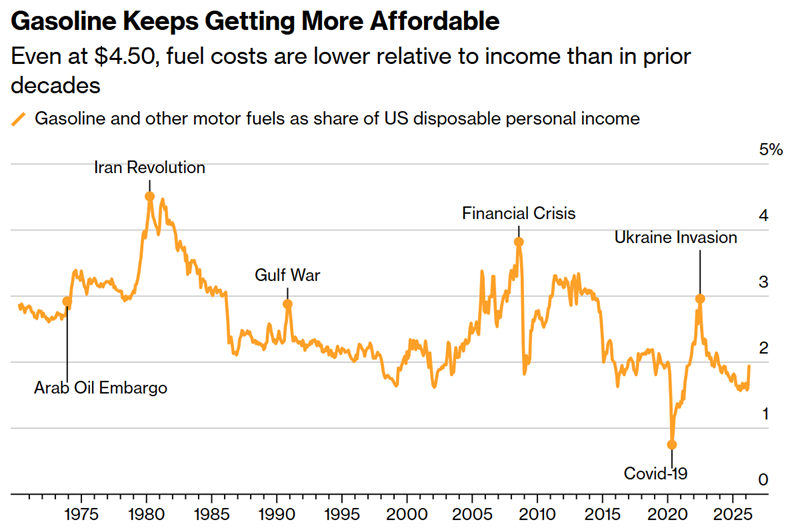
Source: Bureau of Economic Analysis, Bloomberg
And yet the price at the pump packs a much larger political punch than the price at the plug — or the cost of milk for a child’s breakfast cereal. Just like a pint of beer in the UK, a jin of pork in China or a bag of maize meal in southern Africa, how much Americans pay for a gallon of gasoline remains an economic bellwether, even in 2026.
One explanation is the sheer simplicity and ubiquity of gas prices, says Ben Cahill, director of energy markets and policy at the University of Texas at Austin. “There’s very little transparency about healthcare costs, childcare costs, education costs and how they’re rising,” Cahill says. “But you drive down any two-lane highway, there’s one gas station after another showing what the price is. It looms large in the American psyche.”
Another is uniformity. With a few exceptions, a gallon of gas is the same everywhere in the US, allowing for easy comparison across geographies and generations. Retailers cannot hide inflation by shrinking the quantity, as they might with a box of cereal, or offer buy-one-get-one-free deals to soften an imminent price increase.
Nevertheless, there is likely a deeper reason for gasoline’s political power.
From the writings of Mark Twain and Jack Kerouac to the movies of the Wild West, the freedom to travel occupies an essential place in America’s cultural history. In the latter half of the 20th century, that freedom was bound inextricably to the motor vehicle. Imagery of the open road became the backdrop to songs about love and loss, corruption and chaos, risk and reward; think of iconic albums like Bob Dylan’s Highway 61 Revisited (1965) and Bruce Springsteen’s Born to Run (1975).
“Could it be that Americans are a restless people, a mobile people, never satisfied with where they are?” asks John Steinbeck in Travels With Charley: In Search of America (1962). “Nearly every American hungers to move.”
Paying the Political Price
Ronald Reagan seized upon Americans’ innate desire to hit the road in his successful 1980 presidential campaign against Jimmy Carter. The Iranian revolution a year earlier exacerbated an oil crisis that had begun in 1973, leading to fuel shortages across the country. Carter had already, in 1977, asked Americans to rein in their energy use. On the campaign trail, Reagan criticized his opponent’s conservation measures as the “sharing of scarcity.” Soaring gas prices, which reached $1.25 a gallon in 1980, equivalent to $4.43 in 2023 prices, allowed Reagan to ask his famous rhetorical question: “Are you better off than you were four years ago?”
When gas prices are low, “the world is your oyster and nothing can hold you back,” says Patrick de Haan, head of petroleum analysis at GasBuddy, an app that allows users to view and submit prices at filling stations. “You feel like you can do everything.”
Trump knows the power of gas prices in American politics better than anyone. After all, it was he who pilloried then-President Joe Biden when gasoline prices briefly topped $5 a gallon in June 2022, after Covid-19 and Russia’s invasion of Ukraine. Blaming the spike on Biden’s promotion of green energy, Trump created a narrative that Democrats cared more about the planet than the pocketbooks of Middle America.
Right or wrong, Trump’s narrative was a political success. Pledges to “Drill, baby, drill” and to halve energy costs helped Trump sweep to his second presidential term. For a while, it all held together, with the price of gas dipping below $3 a gallon in late 2025.
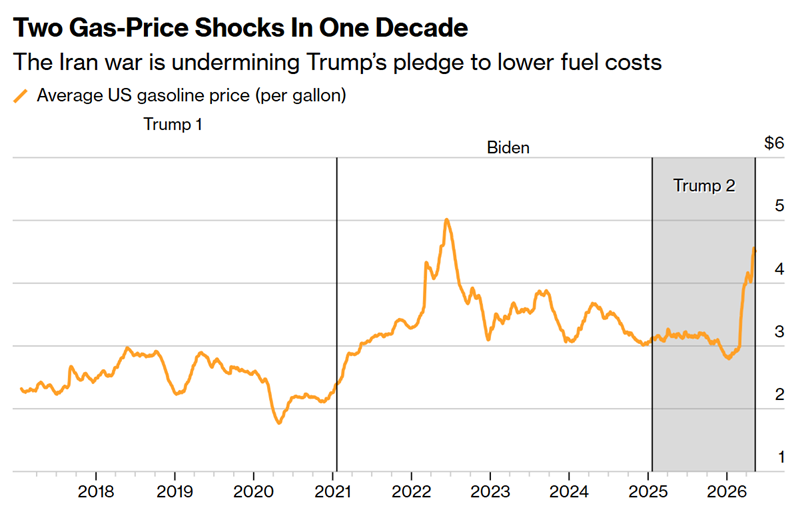
Source: American Automobile Association
But prices are now going in the opposite direction, and Trump’s approval ratings are falling. Rent, food and airfares are also contributing to inflation, which hit 3.8% in April. Still, how much to spend on those is often seen as a personal choice rather than a tax on the freedom to move, as some see rising gas prices.
This helps explain why the US federal tax on gasoline has remained at 18.4 cents a gallon, untouched by Democrat and Republican administrations since 1993, when Bill Clinton entered the White House. (In total, taxes make up about 17% of the cost of a gallon of gas in the US, compared with currently about 50% in the UK.) It is also why Trump just this week voiced support for suspending the tax, to counter rising prices at the pump.
“It feels repressive when gas prices go up,” says De Haan of GasBuddy, whose monthly active users have doubled since the war broke out. “Consumers want to drive, to see new things and get out and experience the world, but the cost of doing so becomes a bit more prohibitive.”
Of course, Trump isn’t the only leader who understands the political weight that gasoline prices carry in America. Just days after US forces assassinated Iran’s Supreme Leader Ayatollah Ali Khamenei earlier this year, Iran responded by using another of Trump’s Art of the Deal negotiating tactics: “Use your leverage.” Iran effectively closed the Strait of Hormuz, instantly choking off nearly a fifth of the world’s supply of crude oil and liquefied natural gas.
The subsequent oil-price spike has brought the US to the negotiating table even after Trump repeatedly claimed complete military victory. Famous for defying political gravity, the president now faces the looming prospect of Republican losses in November’s midterm elections, which are pressuring him to get prices back down, even as he publicly denies any link between the economy and his conduct of the war.
Trump is fortunate that he’s not running for office: In perhaps the ultimate demonstration of the power of the pump, no US president has ever been reelected with brightly lit signs outside gas stations showing prices above $4 a gallon.
Share This:
More News Articles