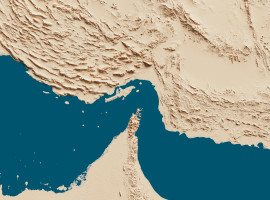
What would the implications be for the oil market if Iran decided to permanently tax/toll traffic through the Strait of Hormuz?
According to Howard Shatz, a senior economist at RAND and a professor of policy analysis at the RAND School of Public Policy, if the U.S.-Iran conflict led to a permanent tax or toll in the Strait, “either oil prices would rise modestly or shipping margins would fall slightly to take account of the extra cost”.
“Most likely, oil prices would rise slightly,” Shatz told Rigzone.
“However, there is little chance that exporters would stand for this,” he warned.
“We would see additional construction of pipelines avoiding the Strait of Hormuz. Pipeline capacity would be added to the Red Sea, to the Mediterranean via Syria or other Levant countries, and to the Mediterranean via Iraq and Turkey,” he added.
“In addition, there could be retaliatory taxation on any trade or services from Iran to the Gulf states. In addition, if such a tax ended up raising oil prices, we might see more exploration and production for oil and gas in other parts of the world that would not be subject to the tax,” he continued.
When Rigzone asked Simon Henderson, the director of the Institute’s Bernstein Program on Gulf and Energy Policy, what the implications would be for the oil market if Iran decided to permanently tax/toll traffic through the Strait of Hormuz, he said, “leaving diplomacy aside, it rather depends on what the toll would be”.
“If large, it would impact the economics of Gulf oil,” he warned.
“But the reality is that the Gulf nations would want to avoid paying it and would look to the U.S. to take diplomatic/military steps to stop it happening,” he told Rigzone.
When Rigzone asked the analysts how much this tax would benefit Iran, Shatz told Rigzone that it depends on the level of tax.
He added, however, that any level of revenue would benefit Iranian leaders “as it would give them more freedom to support their nuclear and missile programs or to fund proxy groups”.
“They could also use it to provide benefits to the population, but that does not seem to be a priority at this time,” he said.
Responding to the question, Henderson told Rigzone that it would depend on whether Iran could access the funds.
“In current circumstances, it seems unlikely,” he added.
Evasion
If a permanent Hormuz tax did come into place, would taxed countries have any choice but to pay these taxes? Could they evade them somehow?
According to Shatz, it is unlikely they could evade them unless they had armed escort.
“But even there, Iran likely would keep a tally and come back later for back-taxes, so this would have to be a permanent armed escort mission and that would be costly,” he warned.
“Therefore, should Iran be able to institute a tax, there would likely be little evasion. However … oil and gas exporters (and exporters of other commodities) would create alternate routes,” Shatz added.
Responding to these questions, Henderson told Rigzone that it would depend entirely on the attitude of the United States.
In a report sent to Rigzone late Tuesday by the Standard Chartered team, Standard Chartered Bank Energy Research Head Emily Ashford noted that, “if some form of Hormuz tariff emerges as a result of the U.S.-Iran negotiations, then any route that bypasses this will benefit from effective exemption from the surcharge”.
Ashford stated in the report that “it is clear to … [Standard Chartered] that regardless of an agreement on transit through the Strait of Hormuz, it can no longer be treated as a permanently secure route, adding a level of operational risk premium to all barrels forced to exit the Gulf by this route”.
Rigzone has contacted the White House and the Iranian Ministry of Foreign Affairs for comment on Shatz and Henderson’s statements and the Standard Chartered report. At the time of writing, neither have responded to Rigzone.
In a release sent to Rigzone on Wednesday, Wood Mackenzie highlighted that, according to a new report from the company, “a prolonged closure of the Strait of Hormuz poses the single greatest threat to global energy markets in decades”.
“Oil prices could reach $200 per barrel in [a] worst case scenario as more than 11 million barrels per day of Gulf crude and condensate supply remains curtailed,” Wood Mackenzie warned in that release.
To contact the author, email