

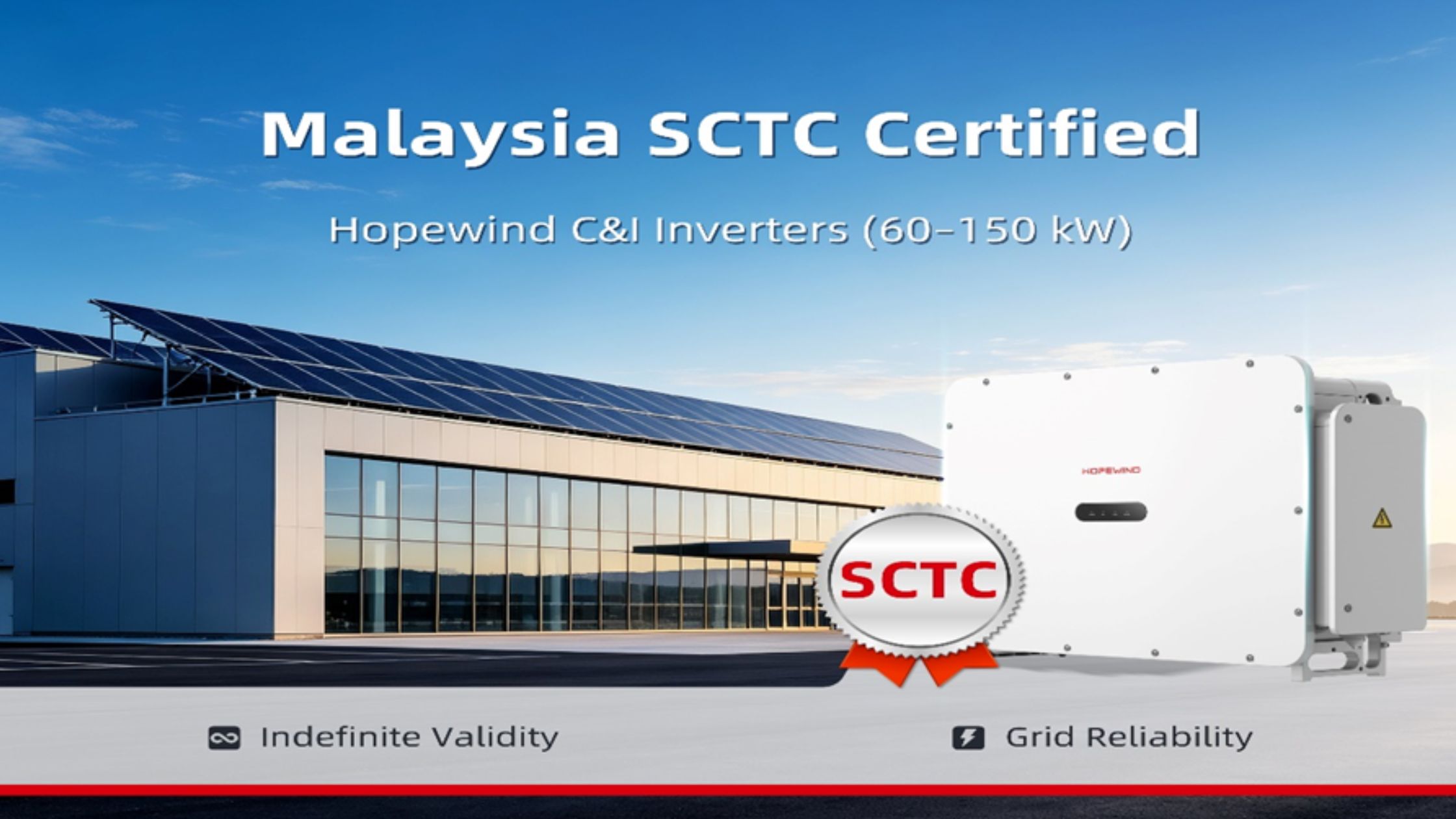
Hopewind has officially been recognized as an approved supplier and manufacturer under Malaysia’s Short‑Circuit Testing and Certification (SCTC) scheme for its full commercial and industrial (C&I) inverter range, spanning 60 kW to 150 kW.
The announcement follows a series of TNB‑witnessed tests at Hopewind’s facility, where the company successfully demonstrated compliance with the rigorous technical requirements set forth by Tenaga Nasional Berhad (TNB).
Meeting Malaysia’s Evolving Grid Standards
The SCTC scheme was introduced under the Technical Guidelines for the Application of Inverters to Mitigate Fault Current Contribution of Inverter‑Based DG in Distribution Systems, jointly developed by TNB and TNB Research. As Malaysia accelerates toward its National Energy Transition Roadmap (NETR) target of 70% renewable energy capacity by 2050, managing fault current contributions from inverter‑based distributed generation (DG) has become a critical priority for grid stability and protection coordination.
During the formal testing process, Hopewind’s C&I inverters proved their capability to minimize short‑circuit current contribution to the distribution network, validating the inverters’ performance under both symmetrical and asymmetrical fault conditions—including residual voltage requirements as specified in the SCTC framework.
What SCTC Approval Means
For engineering, procurement, and construction (EPC) firms and asset owners in Malaysia’s solar sector, Hopewind’s SCTC certification directly translates into lower project costs and streamlined compliance. Because the inverters have already demonstrated compliant fault current mitigation through TNB‑witnessed testing, no additional hardware upgrades—such as current‑limiting reactors or protection add‑ons—are required. This eliminates unforeseen engineering expenditures and accelerates grid connection applications.
Beyond cost and compliance, SCTC approval provides real bankability. Recognized by utilities, regulators, and financial institutions as Malaysia’s definitive benchmark for inverter fault behavior, the certification reduces project risk over the entire operational lifetime. With indefinite validity (provided no hardware or software modifications affect fault current mitigation performance), asset owners gain long‑term assurance that their solar installation meets TNB’s grid stability requirements without recurring re‑certification costs.
Supporting Malaysia’s High‑Renewable Grid Future
As distributed solar capacity grows across Peninsular Malaysia, Sabah, and Labuan, the ability of inverters to manage fault current contributions has become a non‑negotiable baseline. Hopewind’s successful SCTC approval positions the company as a ready‑to‑deploy partner for solar projects in high‑penetration areas, including both medium‑voltage (MV) systems and low‑voltage (LV) installations where fault level mitigation is required.
SCTC compliance is no longer optional—it is the baseline for grid connection in Malaysia’s evolving energy landscape. Hopewind meets that baseline with documented technical integrity and long‑term compliance accountability.
With SCTC approval now secured, Hopewind continues to support the Malaysian solar market with certified, grid‑ready C&I inverters that reduce project cost and accelerate renewable energy adoption.
Subscribe to get the latest posts sent to your email.











%20Expands%20Into%20Renewable%20Energy%20With%20Solar%20Project%20and%20INR%204.86%20Crore%20Solar%20Module%20Order)