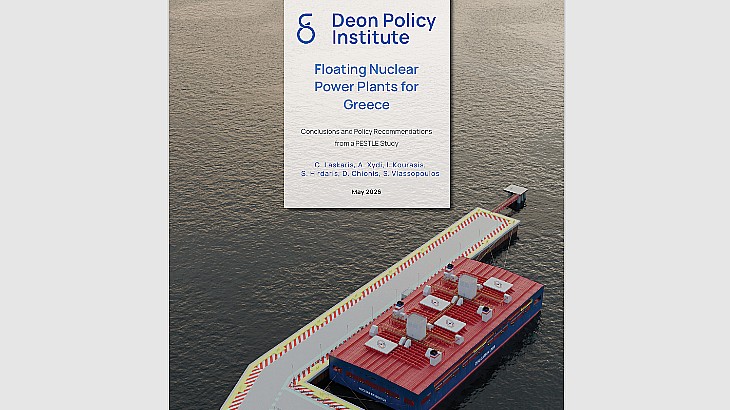
The study derives its policy insights from a research programme conducted by CORE POWER, Athlos Energy – a Greek nuclear company founded in 2024 – and the American Bureau of Shipping. The research, stemming from a two-day workshop held in Athens last October, focused on discussions to assess the political, economic, social, technological, legal and environmental factors that would shape the potential deployment of floating nuclear power plants – or FNPPs – in a European country such as Greece. This is also known as a PESTLE framework.
Greece has historically not deployed nuclear power, but in March this year, Prime Minister Kyriakos Mitsotakis announced at the 2nd Nuclear Energy Summit in Paris that it would examine the potential role of small modular reactors in its energy mix and establish a dedicated ministerial committee to submit proposals to the government, Deon said.
“Given Greece’s long maritime heritage, developed port infrastructure and reinvigorated shipbuilding industry, the potential for deploying FNPPs warrants consideration. FNPPs are also compatible with Greece’s geography and energy markets, given the large number of inhabited islands, the increasing need for desalination and the country’s climate goals,” it added.
Policy, legal and regulatory frameworks in Greece do not yet substantively address nuclear energy or FNPP deployment, reflecting a broader gap in European energy and maritime policy discussions, the study finds. But no fundamental barriers to implementation were identified, “suggesting that the challenge is not one of feasibility, but of framework development”.
notes a need for clearer assessment and regulatory pathways, including coordination across maritime, nuclear and energy authorities, and – while FNPPs are perceived positively – social acceptance of nuclear energy remains low in Greece compared with other countries, implying a need for further education and engagement with both the broader public and key stakeholders.
The combined PESTLE analysis shows that FNPPs should not be seen as a standalone energy project, but a complex strategic choice with public-policy impact, the report notes. The strongest arguments in favour of deploying FNPPs in Greece are primarily environmental and political, as they are directly linked to strengthening the country’s energy autonomy, it concludes, although “critical questions remain open” on financing and economic viability of the technology within the Greek context.
Similarly, while technical obstacles exist, these are mainly due to Greece’s limited domestic nuclear experience. The “most decisive barriers are institutional and temporal. This can be attributed to the lack of enduring political commitment, incomplete regulatory and institutional preparation, and insufficient engagement with society”.
The report calls for “systematic, coordinated action and credible communication, through which Greece can leverage international experience, gradually develop its own nuclear programme, and implement it through maritime applications that demonstrate higher levels of social and political acceptance”, it says, adding that “FNPPs can represent a realistic option for Greece only as the result of a gradual, institutionally organised, and socially prepared strategy”.
“This PESTLE study shows that Floating Nuclear Power Plants are not a distant or purely theoretical option for Greece,” George Laskaris, President of Deon Policy Institute, said. “No fundamental technical or institutional barriers were identified; the real challenge is building the policy, regulatory, financial and social foundations needed for responsible assessment. For Greece, FNPPs sit at the intersection of energy security, decarbonisation, maritime capability and industrial policy.”