Summary
Get the Latest US Focused Energy News Delivered to You! It’s FREE:
- Cushing inventories near operational minimum, risking supply disruptions and crude quality issues
- US crude exports hit record highs as global supply disrupted by Iran war
- Phillips 66 internal estimates show Cushing could hit operational minimum as soon as June end
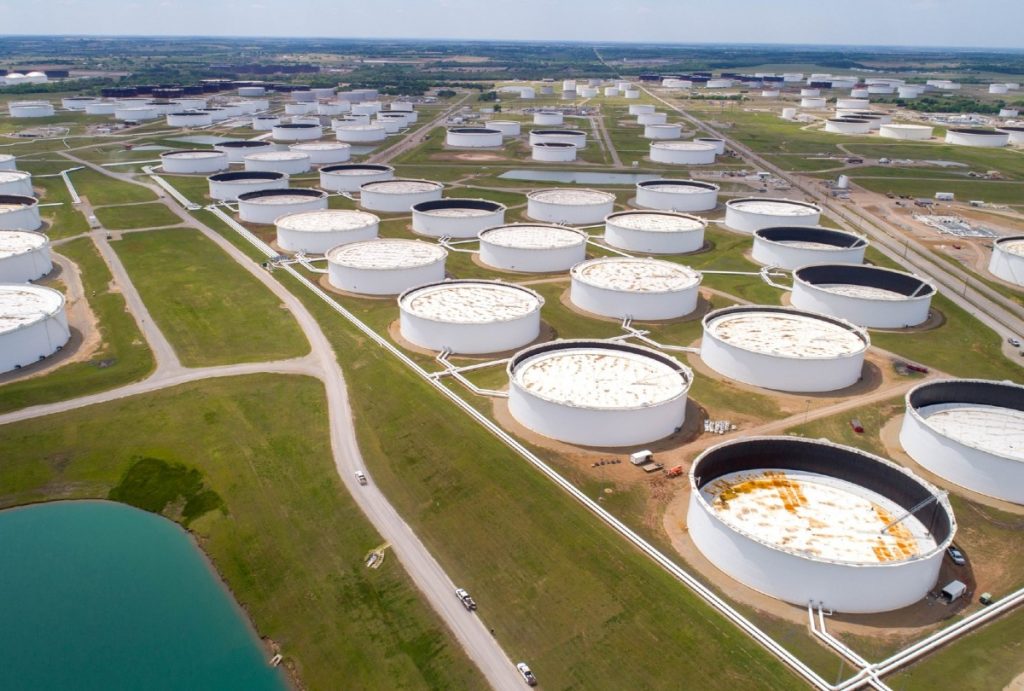
NEW YORK/HOUSTON, June 5 (Reuters) – At the prairie town that calls itself the pipeline crossroads of the world, some 400 oil storage tanks sprawled across Cushing, Oklahoma, are nearly empty, drained by refiners worldwide to plug a massive shortfall in global supplies caused by war in the Middle East.
Cushing is among the largest oil storage hubs in the world. Oil levels in its tanks have fallen rapidly since the war began and Iran effectively closed tanker traffic through the Strait of Hormuz.
Refiners everywhere, seeking to keep the global economy supplied with fuel, have snapped up crude wherever they can find it to substitute the 20 million barrels a day of oil that flowed out of the strait before the war. Since the conflict started, the world has lost over a billion barrels of supply.
Cushing has outsized importance in the global market because it is the delivery point for West Texas Intermediate crude, the variety used as the basis of one of the world’s benchmark oil contracts. Storage levels at Cushing influence the price of tens of billions of dollars’ worth of oil futures traded every day.
Refiner Phillips 66 believes Cushing’s storage levels could reach their operational minimum, according to two sources. For Phillips 66, and a host of other U.S. refiners, Cushing is a major source of crude oil to their plants in the Midwest farm belt and Gulf Coast export hub.
The sources requested anonymity as they were not authorized to speak about internal market forecasts. Phillips 66 declined to comment.
Cushing inventories fell to 22.4 million barrels as of May 29, U.S. government data showed on Wednesday, down about 4 million barrels compared to February 27, the day before the U.S.-Israeli war with Iran began.
Stocks dipped by 500,000 barrels between May 29 and June 2, according to oil storage data provider AlphaBBL that uses drones, planes and satellites to measure and estimate oil storage.
When the level at Cushing gets below 20 million barrels, operational challenges could arise, said Jeremy Irwin, global crude lead for analytics firm Energy Aspects. That level has not been hit since the U.S. lifted its oil export controls in 2015, government data showed.
Cushing has a working capacity to hold about 78.4 million barrels, according to the Energy Information Administration.
“At operational minimum levels, there is not enough oil in a tank to pump out and transfer between tanks and blending becomes a challenge, which could delay or cut outbound flow of oil from Cushing,” Irwin added. Some tanks have outlets at the bottom that can be used to empty oil completely, while others do not, making it challenging to remove oil at the base.
EXPORT SLOWDOWN
Other U.S. storage hubs have also posted large stockpile draws in recent weeks as the country ramped up exports to record levels in recent months.
U.S. crude exports climbed to a record 5.6 million barrels per day in May as the Middle East crisis pushed up demand for American oil from Asian and European refiners.
Overall, U.S. crude inventories have slumped to 43.4 million barrels, after six weeks of draws in a row, falling by about 63.9 million barrels, or 7.5%, since the war began due to strong draw downs in both commercial stocks and the Strategic Petroleum Reserve.
ROARING BACK TO RELEVANCE
Over the past two decades, the Cushing hub’s direct influence on global oil prices has waned due to rapid production growth elsewhere in the U.S., notably in neighboring Texas.
Still, Cushing is strategically located to pull in barrels from top U.S. shale fields and Canada, while its hundreds of tanks are tied to pipelines that supply U.S. mid-continent and southern refineries and funnel oil to Gulf Coast export ports.
U.S. Midwest refiners, which lack access to seaborne imports, would be hit hardest if Cushing stocks fall to the operational minimum. This also raises crude quality concerns. Water and sediments often settle at the base of storage tanks, so oil at the bottom cannot meet quality standards for refiners or exporters.
Poor crude quality or procurement problems could boost prices for refiners and, ultimately, consumers. American motorists are already paying the highest prices in years for gasoline. Soaring diesel prices are a major concern for farmers in the Midwest.
Executives from the two biggest U.S. oil companies, Exxon and Chevron, sounded alarm bells last week at a conference about rapidly falling stockpiles around the world and the risk of sharply higher oil prices in the weeks ahead.
“The buffers and the shock absorbers are being steadily drawn down and the ability for the market to absorb this imbalance is drastically diminished today versus where we started,” Chevron chief Mike Wirth said at a Bernstein conference in New York.
“There’s more upward pressure that I would expect as we get into June and certainly into July,” he said.
Reporting by Shariq Khan in New York; Editing by David Gregorio
Share This:
More News Articles