Monday, 3 February 2025
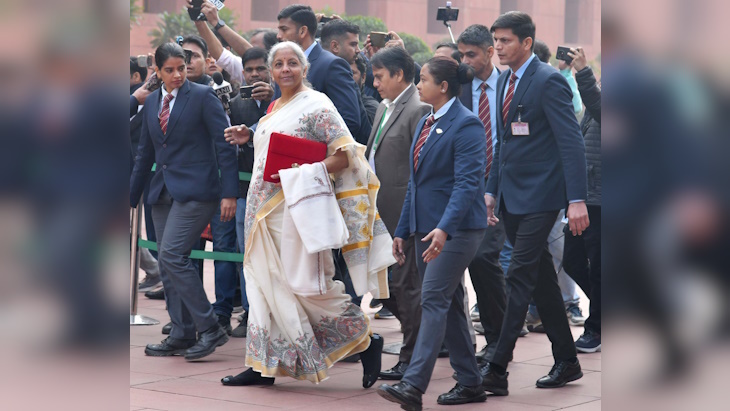
In her budget speech, Sitharaman announced the Nuclear Energy Mission for Viksit Bharat (Viksit Bharat is the government’s strategy to make India into a completely developed nation by 2047).
“Development of at least 100 GW of nuclear energy by 2047 is essential for our energy transition efforts. For an active partnership with the private sector towards this goal, amendments to the Atomic Energy Act and the Civil Liability for Nuclear Damage Act will be taken up,” Sitharaman said.
“A Nuclear Energy Mission for research & development of Small Modular Reactors (SMRs) with an outlay of INR20,000 crore will be set up. At least 5 indigenously developed SMRs will be operationalized by 2033.”
INR20,000 crore is around USD2.5 billion (1 crore is 10 million).
This follows commitments in 2024’s budget to partner with the private sector on the development of the Bharat Small Modular Reactor – a compact 220 MW pressurised heavy water reactor based on India’s reactor technology.
The Atomic Energy Act of 1962 prohibits private control of nuclear power generation in India: only two government-owned enterprises – NPCIL and Bharatiya Nabhikiya Vidyut Nigam Limited (BHAVINI, set up to build and operate fast reactors) – are legally allowed to own and operate nuclear power plants in India. Amendments to the act made in 2016 allow public sector joint ventures, but private sector companies and foreign investments are not allowed to invest directly in nuclear power in India.
The Civil Liability for Nuclear Damage Act of 2010 places responsibility for any nuclear accident with the plant operator and limits total operator liability – but allows the operator to have legal recourse to the reactor supplier, with no limit on supplier liability. This has been a stumbling block for overseas nuclear power plant vendors.
According to a statement from India’s Department of Atomic Energy, the legislative changes are expected to create a more conducive environment for investment and innovation in the nuclear sector. The mission aligns with India’s commitment to achieving 100 GW of nuclear energy capacity by 2047, a milestone deemed essential for reducing carbon emissions and meeting future energy demands.
India is already working to expand its nuclear capacity from 8180 MW today to 22,480 MW by 2031-2032, including the construction and commissioning of ten units totalling 8,000 MW across Gujarat, Rajasthan, Tamil Nadu, Haryana, Karnataka, and Madhya Pradesh, the DAE said. Pre-project activities for a further ten reactors are under way, and in-principle approval has been given for the construction of up to six units in cooperation with the USA: a site at Kovvada, in Andhra Pradesh, was earmarked for the construction of six AP1000 pressurised water reactors as long ago as 2016, but contractual arrangements have yet to be finalised.
In early January, India’s nuclear power operator NPCIL issued a Request for Proposals from ‘visionary Indian industries’ to finance and build a proposed fleet of 220 MW Bharat Small Reactors to help decarbonise Indian industry.
“Civil nuclear energy will ensure a significant contribution to the country’s development in future,” Prime Minister Narendra Modi said in his response to the budget, which he said includes “significant steps” towards reforms.
India’s budget is presented on 1 February, ahead of the start of the financial year on 1 April. Last year, due to Lok Sabha elections, an interim budget was presented in February: the full budget for 2024-2025 was not presented until July.