By
19 min ago 3 min read
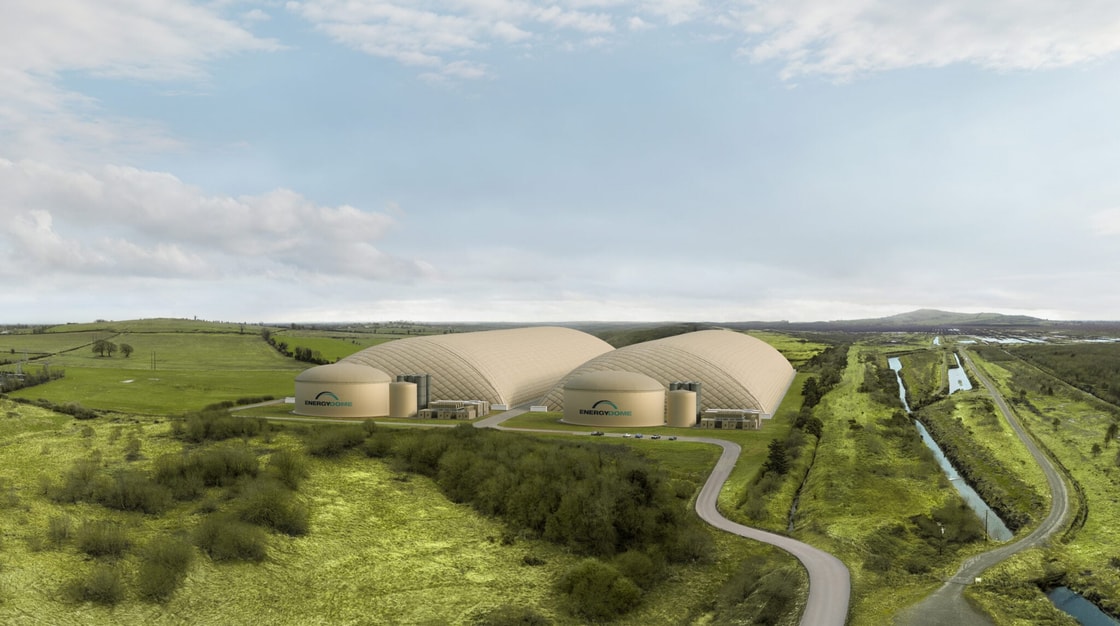
Global technology firm Google and Italian carbon dioxide (CO2) battery developer Energy Dome have announced a 23MW/200MWh CO2 battery project in County Offaly, Ireland.
This marks the first bilateral commercial agreement between Google and Energy Dome, after announcing plans to deploy Energy Dome’s CO2 battery long-duration energy storage (LDES) technology globally .
The CO2 battery project has secured a grid connection to the Greater Dublin network and is expected to be commissioned in 2028.
The site has been awarded a 10-year capacity contract from EirGrid, the state-owned electric transmission system operator.
Energy Dome will own and operate the site, with plans to add a second 200MWh battery to create a domestic LDES hub in Ireland.
The company’s CO2 battery technology uses grid power to compress and store CO2. The stored CO2 can then be expanded through a turbine to generate energy when required by the grid.
The CO2 battery supports grid reliability by absorbing surplus renewable generation to provide energy in times of peak demand.
Claudio Spadacini, CEO of Energy Dome, said, “[This project] strengthens grid resilience and unlocks the path to 24/7 carbon-free energy in Ireland.”
Google and Energy Dome believe the project will provide a reference framework for LDES deployment to support the Irish government’s aim to use 80% renewable electricity by 2030.
In 2023, 40.7% of Ireland’s electricity was sourced from renewable energy and the country’s use of renewables avoided 7.4 million tonnes of CO2 emissions, according to the Sustainable Energy Authority of Ireland (SEAI).
Energy Dome has already entered commercial deployment and has multiple projects contracted, including with in the US, in Italy, and in India.
Google, Energy Dome and local utility company SRP recently announced the development of a 19 MW/200MWh CO2 battery project in Arizona.
LDES CO2 battery technology can be used to meet increasing energy demand from data centre infrastructure.
Global data centre power demand currently stands at 460 TWh in 2026, equivalent to around half of Japan’s total power generation. Wood Mackenzie that figure will reach 1,280 TWh by 2030 and 3,700 TWh by 2040, a 704% increase from current levels.