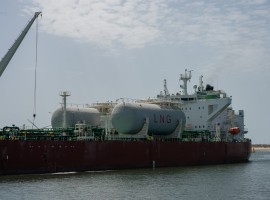
Drone view of oil tanker HELGA berthed at one of Iraq’s southern offshore oil terminals near Basra as it prepares to load crude oil, becoming the second vessel to arrive since the closure of the Strait of Hormuz, April 24, 2026. REUTERS/Mohammed Aty/File Photo
Summary
- Prices pressured by US-Iran talks, sanctions relief
- More vessels transit Hormuz, underpinning optimism
- US crude inventories continue to fall
BENGALURU, June 24 (Reuters) – Brent crude oil prices fell more than 1% on Wednesday to the lowest in nearly four months, extending losses on signs that more oil tankers are set to move out of the Strait of Hormuz.
Get the Latest US Focused Energy News Delivered to You! It’s FREE:
Brent crude futures were down $1.20, or 1.56%, at $75.88 a barrel by 1001 GMT. U.S. West Texas Intermediate slipped by $1.14, or 1.6%, to $72.07.
Brent touched a low of $75.37, its weakest level since February 27, the day before the start of U.S.-Israeli strikes on Iran. WTI fell as low as $71.55, the weakest since March 3.
“While there are early encouraging signs of increased tanker activity, the market is pricing in the broader scenario of Iranian oil re-entering the global market and the Strait of Hormuz normalising,” said Tim Waterer, chief market analyst at KCM Trade.
“If sanctions are eased, Iranian production and exports could ramp up relatively quickly given the substantial amount stored on tankers — we are likely talking weeks rather than months,” Waterer added.
Adding to signs of market weakness, physical crude oil cargoes are selling at discounts across the globe, changing trade flows as markets come under pressure from fast-rising Middle Eastern supply with Iran set to boost sales following a temporary reprieve from U.S. sanctions.
Oman said it would keep the Strait of Hormuz open to shipping without imposing any tolls and had designated two temporary routes north and south of the existing shipping lane to facilitate the safe passage of vessels departing the region.
Prices have also come under pressure this week from the 60-day sanctions waiver Washington granted Tehran after initial peace talks, allowing Iran to sell oil, and from an easing of hostilities in Lebanon.
Ship-tracking data showed that three stranded supertankers passed through the strait on Tuesday. The U.N. shipping agency said an evacuation plan is under way to enable hundreds of stranded ships to sail through the strait after the U.S.-Iran ceasefire deal.
Uncertainty remains over the durability of the accord, however. U.S. President Donald Trump said on Tuesday that Iran had agreed to nuclear inspections into “infinity”, though Tehran said it had made no such concession.
“Markets are currently assigning too much confidence to a favorable outcome without fully discounting the risks associated with unresolved nuclear issues and inspection disputes,” said Mark Malek, CIO at Siebert Financial.
Investors are also watching how quickly Middle Eastern producers can restore exports and whether more ships will enter the region.
Macquarie expects Brent to average $77.09 a barrel in 2026 before sliding to $64 in 2027.
Reporting by Anushree Mukherjee in Bengaluru, Yuk
Share This:
More News Articles