The new group established by the council (the Conselho Nacional de Política Mineral) has been given 90 days to “assess the current state of mapping and knowledge about uranium mineral resources and reserves, and to propose strategies to expand this information. The committee will also be responsible for determining the mineral production potential, considering ongoing and future projects”.
It will be run under the supervision of the Ministry of Mines and Energy and will bring together various government departments, the navy and Ministry of Defence as well as nuclear operator Eletronuclear and Indústrias Nucleares do Brasil (INB).
Tomas Albuquerque, INB President, said: “We have an incredible window of opportunity and a window of concern. Today, the world produces 60,000 tonnes of uranium and will consume 65,000 tonnes … 5,000 tonnes have come from strategic reserves held by countries and the nuclear power plants themselves.”
He said that demand was going to increase across the world as new units are built, and Brazil itself, which has plans to expand nuclear capacity, will need to expand its uranium production just to meet its own demand “and actually having this uranium requires significant investments”, he said.
State-owned INB launched the Pró-Urânio programme in 2024 “with the aim of expanding and accelerating the exploration of new deposits, and which will involve BNDES (Brazilian National Bank for Economic and Social Development) in developing the model for partnerships with mining companies”.
A Request for Information was launched by Brazil’s National Bank for Economic and Social Development in December for consulting firms interested in participating in the programme.
Background
According to World Nuclear Association, following active exploration in the 1970s and 1980s, Brazil has reasonably assured resources of 210,000 tonnes of uranium.
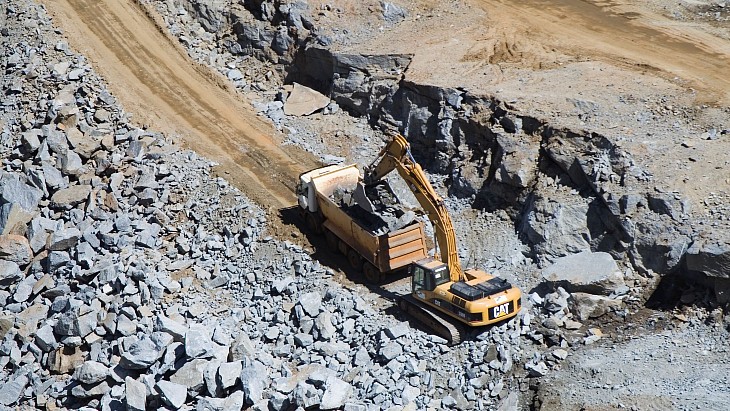
Uranium has been mined in Brazil since 1982, but the only operating mine is INB’s Lagoa Real/Caetité mine, with a capacity of 340 tU per year. The mine has known resources of 10,000 tU at 0.3%U.
It has been developing the Santa Quitéria Project, which is currently in the preliminary environmental licensing process with the Brazilian Institute of Environment and Renewable Natural Resources (IBAMA) – it was accepted for environmental review in March 2022.
The project is to be implemented at Fazenda Itataia, in the municipality of Santa Quitéria. The collophanite deposit at Itataia is composed of 99.8% phosphate and 0.2% uranium. The deposit – located in the interior of the state of Ceará – is the largest discovered uranium reserve in Brazil.
INB has said the projected annual production is approximately 1.05 million tonnes of phosphate fertiliser and 220,000 tonnes of dicalcium phosphate for animal feed as well as producing “approximately 2,300 tonnes of uranium concentrate per year, destined to supply the Angra 1, Angra 2, and, in the future, Angra 3 nuclear power plants. This initiative reinforces the country’s strategy of self-sufficiency in nuclear fuel production, with potential for export”.
According to figures reported at the time plans for the project were announced in 2020, the Itataia deposit has an estimated 142,200 tU, inter-mixed with phosphates. The deposit has exploitable reserves of 79.5 million tonnes of ore, at grades of 11% P2O5 and 0.0998% U3O8, equating to about 8.9 million tonnes of P2O5 and 79.3 thousand tonnes of U3O8.
Brazil has a long-established nuclear energy sector. Two pressurised water reactors – Angra 1 and 2 – supply about 3% of the country’s electricity. There are also plans to complete a third unit at Angra and potential new capacity is being explored, including via a microreactor being developed in the country.