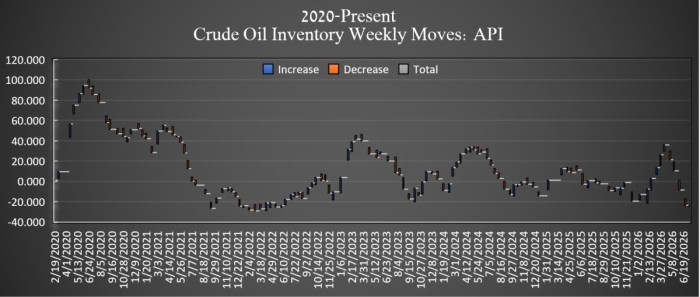
The American Petroleum Institute (API) estimated that crude oil inventories in the United States fell by 564,000 barrels in the week ending July 10. In the week prior, US crude oil inventories fell by 399,000 barrels.
Although commercial crude oil inventories excluding the SPR have been falling rapidly for three months now, shedding just over 60 million barrels over the last twelve weeks, US crude inventories are only down 9.2 million barrels so far this year, according to API data, kept in check by draws from the SPR.
For the week ending July 10, another 2.99 million barrels left the SPR, bringing the new total to 316.5 million barrels—lower than the 2023 low reached during the Biden Administration’s huge drawdown and the lowest level in over 43 years. SPR inventories are now 415 million barrels shy of maximum capacity.
It’s important to note that the generally accepted operational minimum for oil in the SPR is between 250-300 million barrels, below which the reserve may find it difficult to pump and process oil efficiently.
US production has risen in response, with production for the week ending July 3 rising to 13.860 million bpd. This is up from 13.810 in the week prior, and up 475,000 bpd from a year earlier.
At 4:04 pm ET on Tuesday, Brent crude was trading up on the day at $85.17 (+2.24%) as US/Iran tensions escalated once again.
WTI was also trading up on the day, by $1.50 per barrel (+1.92%) at $79.64.
Gasoline inventories fell this week, by 1.664 million barrels in the week ending July 10. In the week prior, gasoline inventories decreased by 2.929 million barrels. In the week prior, gasoline inventories were already 6% below the five-year average for this time of year, according to the latest EIA data.
Distillate inventories rose by 2.3 million barrels, after dropping 1.801 million barrels in the week prior. Distillate inventories were already 12% below the five-year average as of the week ending July 3, the latest EIA data shows.
Cushing inventory—the inventory kept at the delivery hub for the WTI Crude futures contract—rose by 238,000 barrels over the reporting period after falling 69,000 barrels in the week prior.
By Julianne Geiger for Oilprice.com
More Top Reads From Oilprice.com
- U.S. LNG Exporter Reaps Windfall as Middle East Turmoil Drives Fees Higher
- Oil Prices Jump After Iran Attacks Commercial Vessels
- US Crude Oil, Product Inventories Fall Even As Hormuz Traffic Begins to Flow